
Victoria Double Florin (1887–1890)
“Barmaid’s Ruin” • Jubilee Head • Exploring the Varieties by Davies
Introduction
The Victoria Double Florin, struck from 1887 to 1890, was a bold experiment in British coinage. With a face value of four shillings, it was intended to simplify transactions during the early years of Queen Victoria’s Jubilee Coinage series. However, its near-identical size to the crown led to immediate public confusion — earning it the enduring nickname “Barmaid’s Ruin.”
Despite its short life, the Double Florin fascinates collectors due to its multiple die pairings, subtle legend variations, and transitional hub designs. This page explores those varieties in depth, using Davies numbers as reference, alongside historical context and mintage notes.
Historical Background
The Double Florin was introduced as part of the Jubilee coinage reform of 1887, designed by Sir Joseph Edgar Boehm and engraved by Leonard Charles Wyon. The goal was to modernize coin designs and introduce a convenient mid-value silver denomination between the florin and the crown.
Unfortunately, its close size to the crown (only 2 mm smaller) led to frequent confusion in taverns and shops. Many of the coins were withdrawn or exported soon after issue, making surviving examples a compact but fascinating field for study.
The series also captures a key artistic transition: the Jubilee bust reflects Victorian imperial confidence, yet was widely criticized for its flat relief and ill-fitting small crown.
General Information
- Monarch: Queen Victoria (1837 – 1901)
- Denomination: Double Florin (4 Shillings)
- Date Range: 1887 – 1890
- Composition: Sterling Silver (0.925 fine)
- Weight: 22.62 grams (ASW 0.6727 oz)
- Diameter: 36 mm
- Edge: Milled
- Obverse Designer: Sir J. E. Boehm (JEB on truncation)
- Reverse Designer: Leonard Charles Wyon
- Obverse Legend (Latin): VICTORIA DEI GRATIA BRITT: REGINA FID: DEF:
- Reverse: Cruciform shields with sceptres, crown above, Order of the Garter center.
- Mint: Royal Mint – London
- Circulation Years: 1887, 1888, 1889, 1890
- Nickname: “Barmaid’s Ruin” or “Barmaid’s Grief”
Details of the Varieties
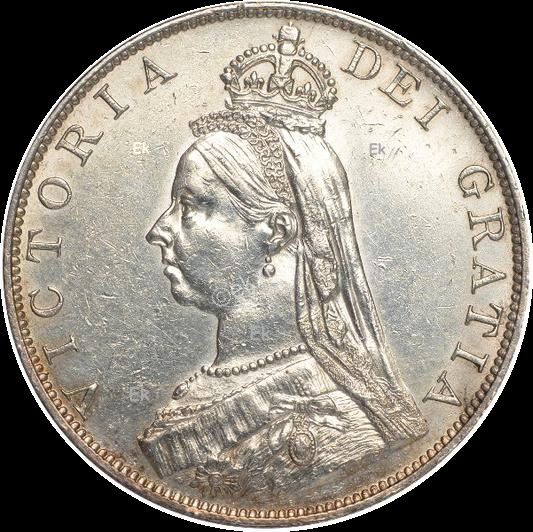
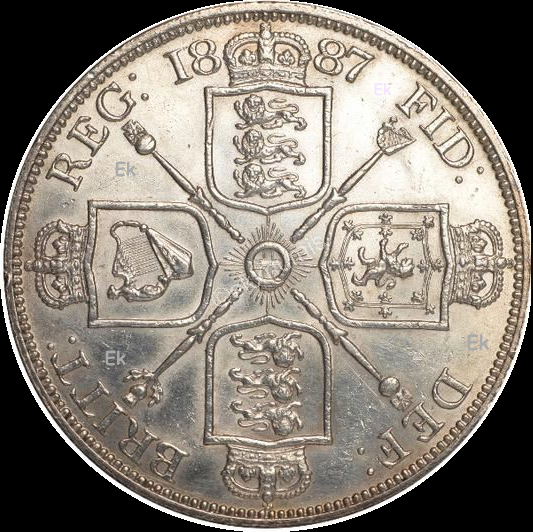
1887 • Roman “I” in Date — Davies 540
The earliest Double Florin type of 1887 displays a Roman “I” in the date (I887).
Usually paired as Obv 1 + Rev A, this combination appears in proof and early circulation issues.
The obverse fields are flat and the rim less concave than later dies.
| Obverse | Reverse |
 |
 |
References:
- Bull – 2695
- Davies – 540
- Coins of England – 3922
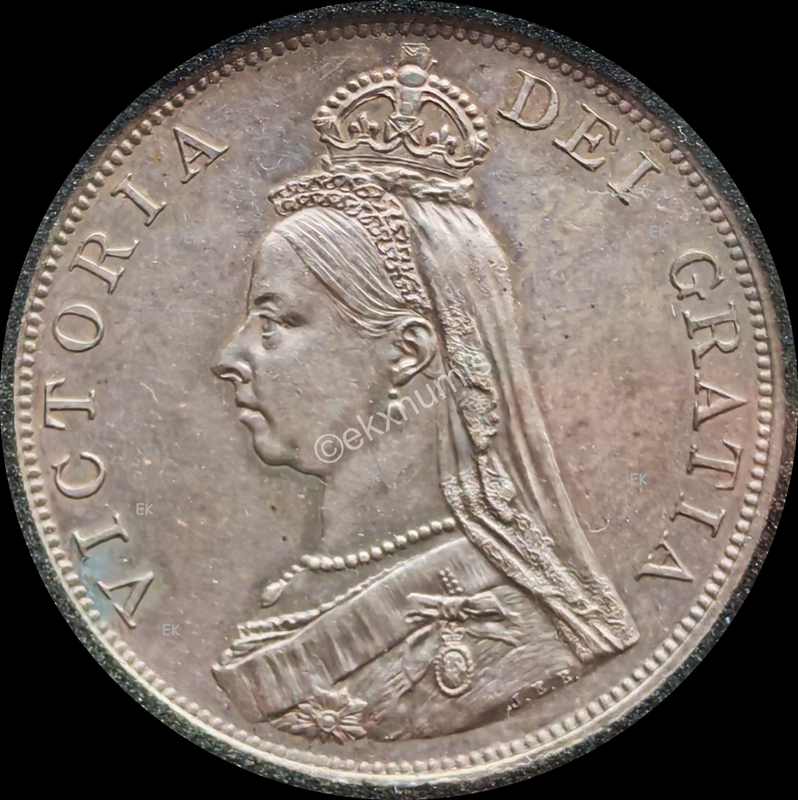
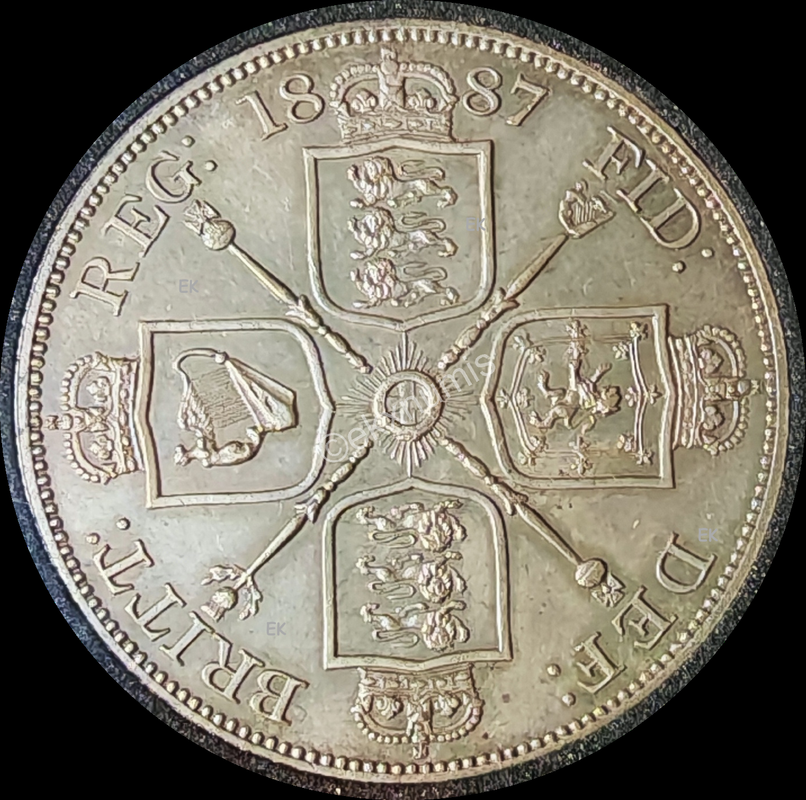
1887 • Arabic “1” in Date — Davies 541
The standard circulation type of 1887, showing an Arabic “1” in the date.
Dies 2 + B (Obv 2 + Rev B). Seen in both proof and business-strike formats.
Reverse design is slightly recessed with a more pronounced rim.
| Obverse | Reverse |
 |
 |
References:
- Bull – 2967
- Davies – 541
- Coins of England – 3923
1887 • Arabic “1” with Early Obverse (Mule) — Davies 540a
A rare mule pairing the early obverse 1 with the Arabic 1 reverse B. Displays a subtle mismatch in rim height and alignment of the crown cross. Scarcer than both 540 and 541.
| Obverse | Reverse |
 |
 |
References: Londoncoins.co.uk
- Davies – 540A
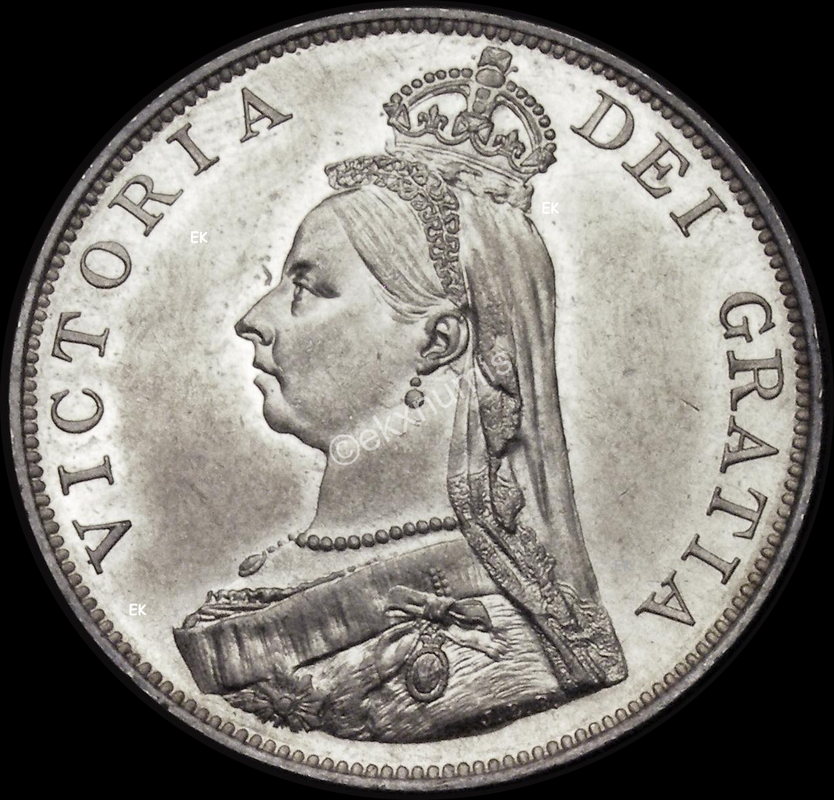
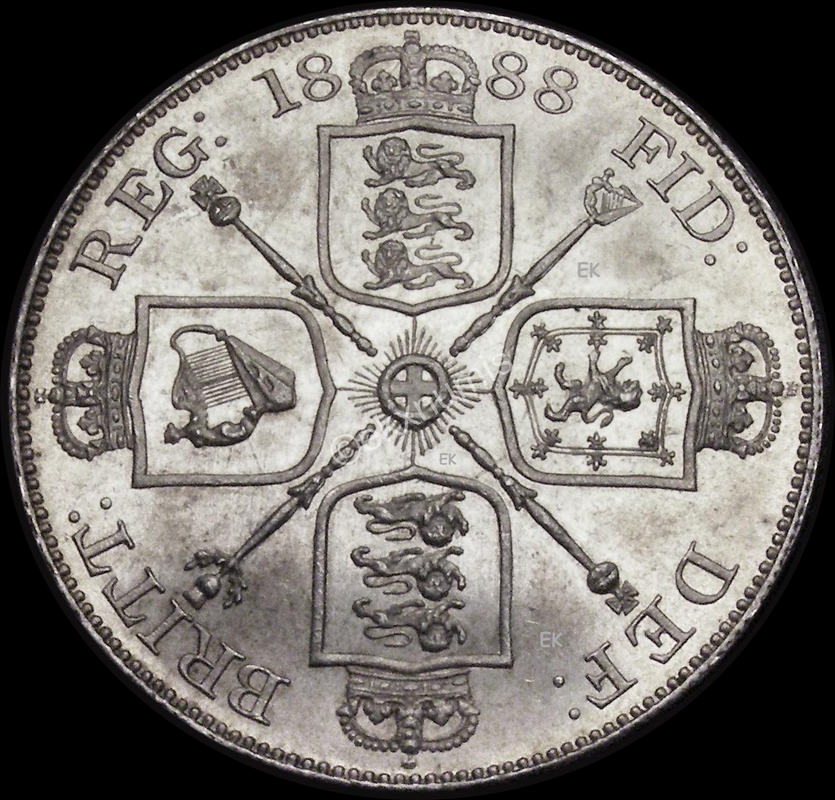
1888 • Normal Legend — Davies 542
Standard 1888 issue with normal legends and punctuation.
Dies 2 + B. Common in mint state; the workhorse variety for the year.
| Obverse | Reverse |
 |
 |
References: Peter J Davies
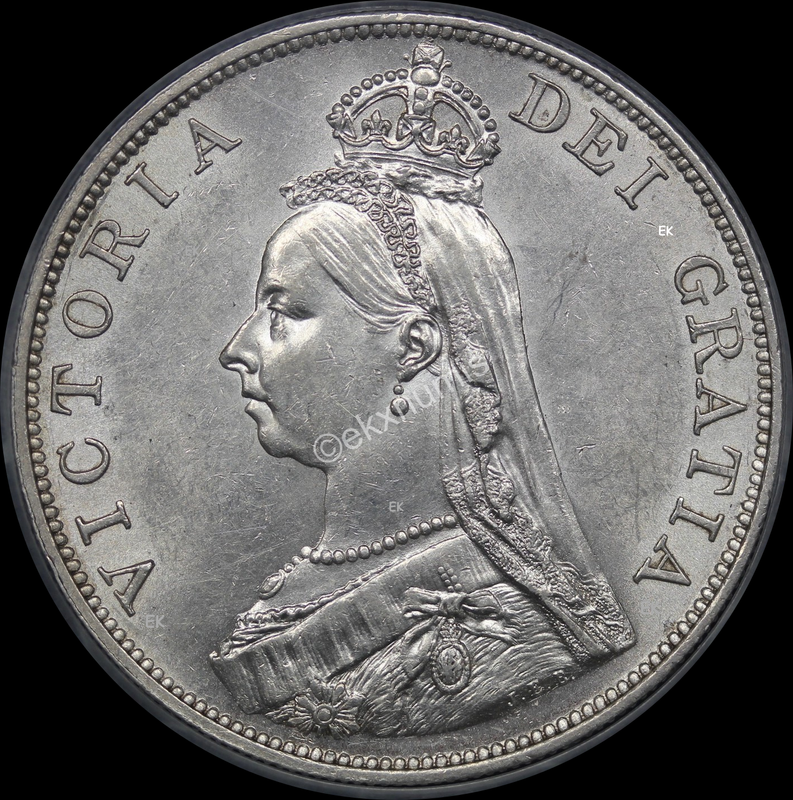
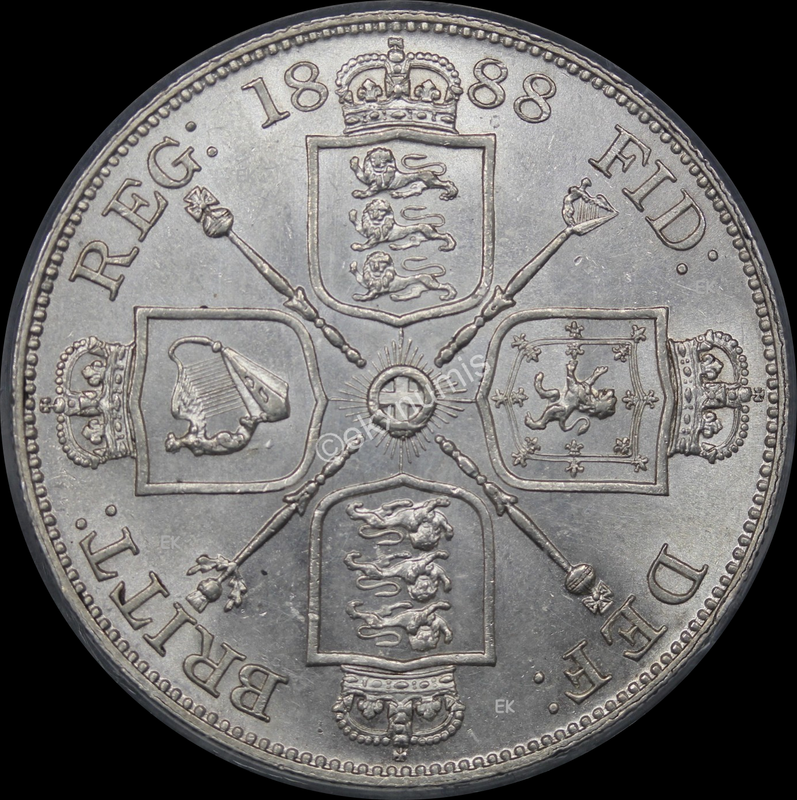
1888 • “Inverted 1” in VICTORIA — Davies 543
A popular blundered legend where the second I of VICTORIA is punched with an inverted “1”.
Same dies as 542 (2 + B). Often shows light die-polish lines.
| Obverse | Reverse |
 |
 |
References: Peter J Davies
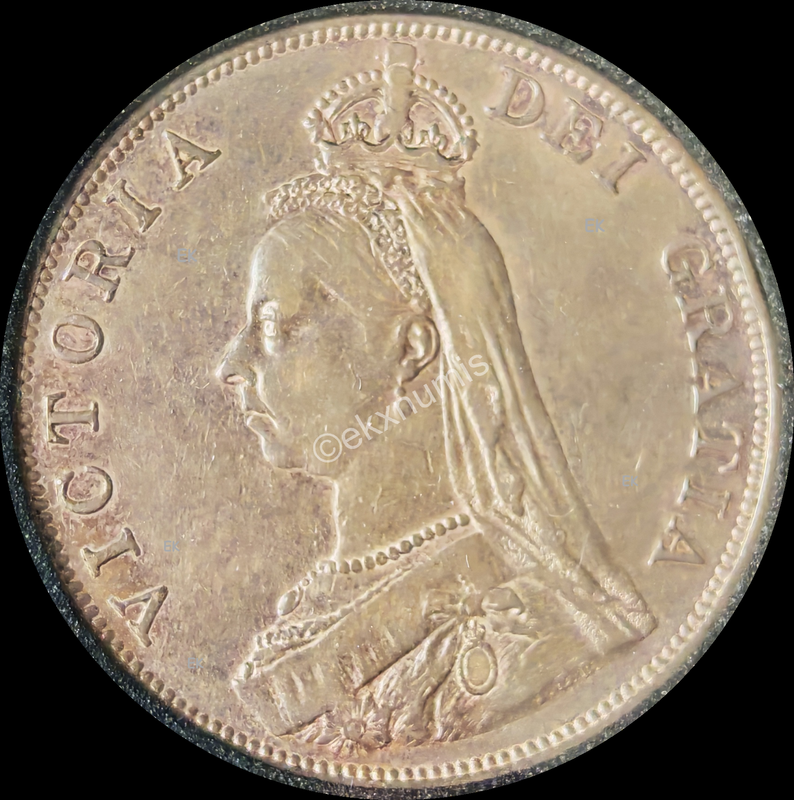
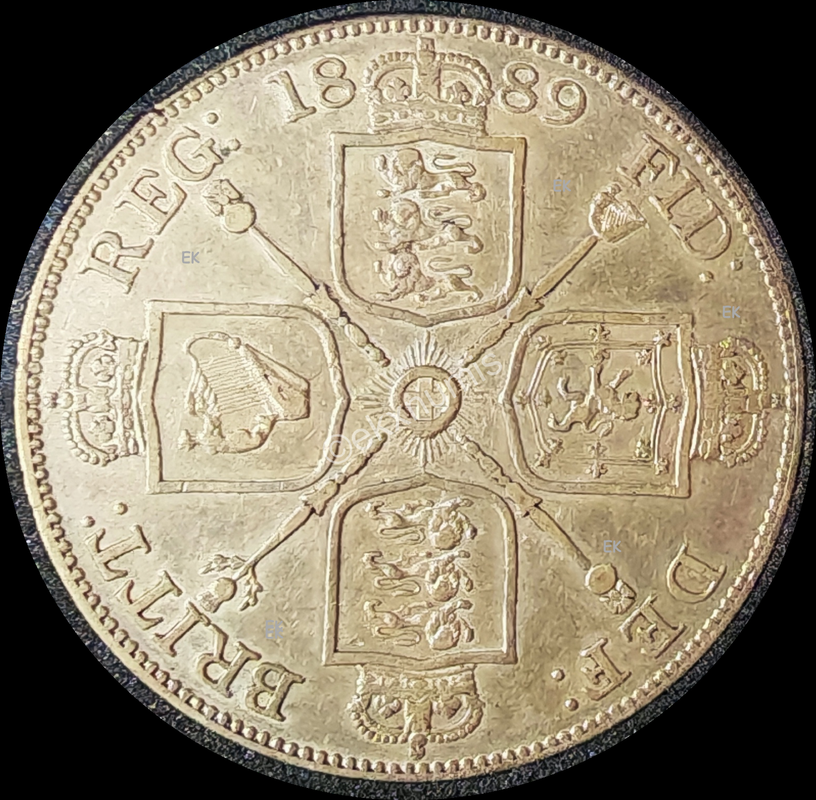
1889 • Normal (Enlarged Reverse Hub) — Davies 544
The principal 1889 type, using the enlarged reverse C hub with broader shields and larger sceptre crosses.
Dies 2 + C. Well-struck pieces show superb detail on St George’s shield.
| Obverse | Reverse |
 |
 |
References: Peter J Davies
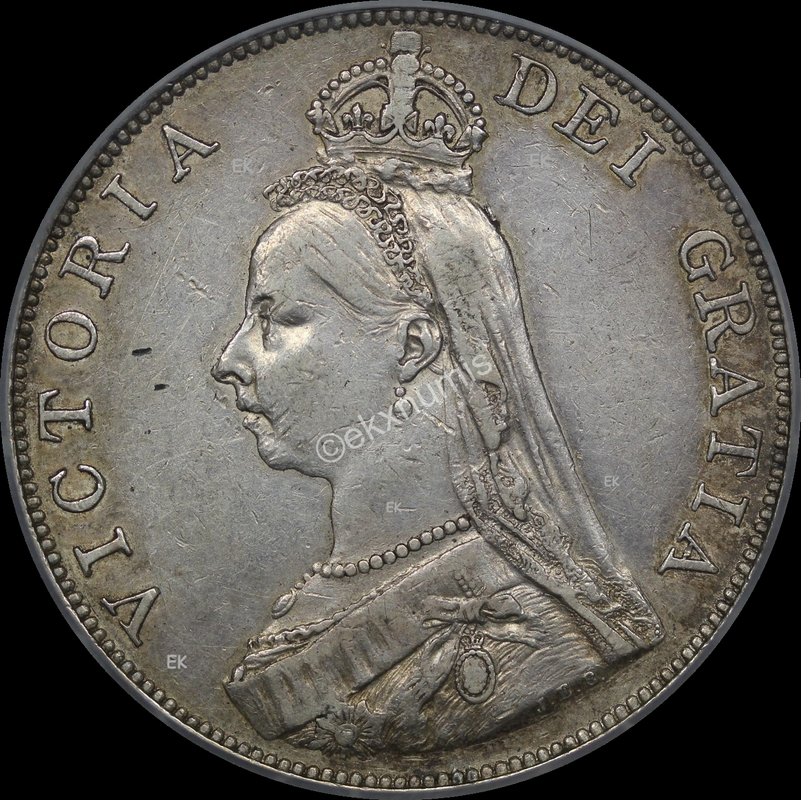
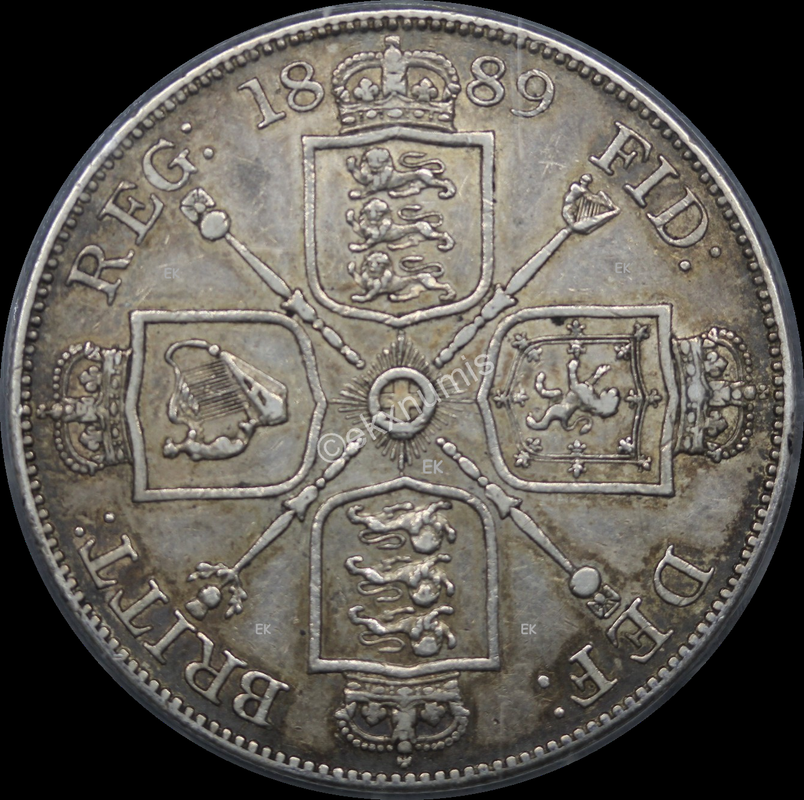
1889 • “Inverted 1” in VICTORIA — Davies 545
A popular blundered legend where the second I of VICTORIA is punched with an inverted “1”.
Same dies as 544 (2 + C). Often shows light die-polish lines.
| Obverse | Reverse |
 |
 |
References: Peter J Davies
1889 • Small Sceptre Cross — Davies 544a
A transitional reverse using the smaller cross (rev B) carried over from 1888. Distinguish by the narrower cross tips and tighter shield spacing. Less common than 544.
| Obverse | Reverse |
 |
 |
References: londoncoins.co.uk
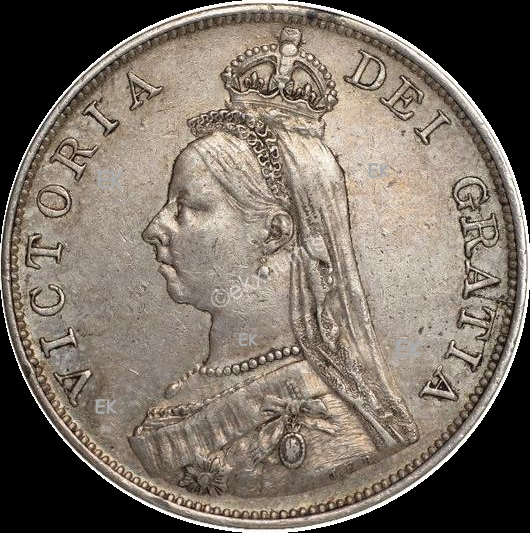
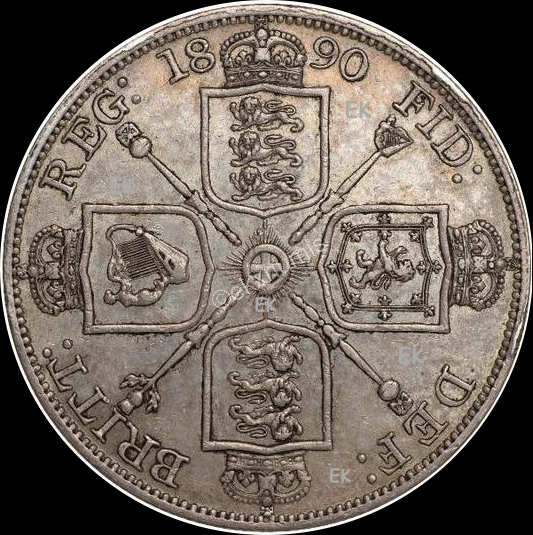
1890 • Normal Late Hub — Davies 546
The final year of issue, pairing dies 2 + C with the enlarged hub.
Strikes are often sharp and lustrous. Commonest date in higher grades.
| Obverse | Reverse |
 |
 |
References: Peter J Davies
Proof Issues
The Proof Double Florins of 1887 were struck in limited numbers for official Jubilee Proof Sets issued by the Royal Mint. These display deeply mirrored fields, frosted reliefs, and squared rims. Two principal proof die pairings are recorded: Roman “I” date (Davies 540; dies 1 + A) and Arabic “1” date (Davies 541; dies 2 + B).
Alongside the true proofs, a small number of specimen or prooflike strikes exist from later years (1888–1889). These were struck on superior blanks with lightly polished dies but lack the fully mirrored finish of official proofs.
Occasionally, lightly polished extended circulation pieces from 1887–1890 show semi-reflective surfaces, leading to misattribution. Genuine circulation issues typically show standard strike pressure, rounded rims, and less precise frosting on portrait details.
1887 • Roman “I” Proof — Dies 1 + A
The Roman “I” proof Double Florin represents the earliest die pairing of the series
(Obv 1 + Rev A), reserved primarily for the full Jubilee proof sets.
It displays the distinctive “I887” date and a slightly flatter portrait relief.
The mirrored fields are often deep and dark, contrasting with the matte frosting of Victoria’s bust.
| Obverse | Reverse |

|

|
References: Sovereign Rarities • VCoins • LondonCoins Archive
1887 • Arabic “1” Proof — Dies 2 + B
The Arabic “1” proof was struck for short silver proof sets and a small number of individual presentations.
It combines Obv 2 + Rev B dies, showing a slightly more concave rim and crisp detailing on the sceptres.
This version is sometimes misidentified as a currency strike, but its sharp squared edge
and mirror finish distinguish it clearly from circulation issues.
| Obverse | Reverse |

|

|
References: Sovereign Rarities • CoinArchives • Biddr Sales
Quick Reference Table
| Year | Variety / Description | Davies Ref. No. | Die Pairing | Availability | References / Sources |
|---|---|---|---|---|---|
| 1887 | Roman “I” in Date | Davies 540 |
Obv 1 + Rev A | Common in Proof • Scarcer in circulation | Peter J Davies |
| 1887 | Arabic “1” in Date | Davies 541 |
Obv 2 + Rev B | Standard type • Proof & Circulation | Peter J Davies |
| 1887 | Arabic “1” with Early Obverse (Mule) | Davies 540A |
Obv 1 + Rev B | Scarce | LondonCoins.co.uk |
| 1888 | Normal Type | Davies 542 |
Obv 2 + Rev B | Common | Peter J Davies |
| 1888 | “Inverted 1” for second I in VICTORIA | Davies 543 |
Obv 2 + Rev B | Scarce • Error variety | Peter J Davies |
| 1889 | Normal (Enlarged Reverse Hub) | Davies 544 |
Obv 2 + Rev C | Common | Peter J Davies |
| 1889 | Small Sceptre Cross (Earlier Reverse) | Davies 544a |
Obv 2 + Rev B | Scarce | LondonCoins.co.uk |
| 1890 | Normal Late Hub | Davies 546 |
Obv 2 + Rev C | Commonest in high grade | Peter J Davies |
Note: Proofs occur for 1887 Roman “I” (Davies 540) and Arabic “1” (Davies 541). Minor die polish and hub changes within years are not listed separately.
Proof Reference Table
| Type | Year(s) | Davies No. | Die Pairing | Finish / Characteristics | Notes / Occurrence |
|---|---|---|---|---|---|
| Official Proof (Roman “I”) |
1887 | Davies 540 |
Obv 1 + Rev A | Deep mirror fields, frosted bust, squared rims | Issued in full Jubilee Proof Sets • Scarcer in isolation |
| Official Proof (Arabic “1”) |
1887 | Davies 541 |
Obv 2 + Rev B | Brilliant mirrored fields, slightly concave rims | Issued in short silver proof sets and as individual proofs |
Note: Only 1887 issues were struck as official proofs. Later polished or specimen pieces should not be catalogued as proofs unless die and surface analysis confirms proof manufacture.
Proof • Specimen • Circulation Comparison
| Feature | Proof | Specimen / Prooflike | Circulation Strike |
|---|---|---|---|
| Manufacture | Specially prepared dies and polished planchets, struck multiple times under high pressure. | Early die strikes on selected blanks; single strike, moderate pressure. | Standard die and blank preparation; single strike for general issue. |
| Fields | Highly mirrored, deep reflectivity with frosted relief. | Semi-reflective or glossy; light die-polish lines visible. | Matte or satin; minimal reflectivity. |
| Rims | Squared and sharp, uniform thickness. | Sharp but slightly rounded at edges. | Rounded and often uneven from die wear. |
| Relief & Detail | Extremely sharp with full device frosting and polished fields. | Good strike with moderate contrast; details crisp but less depth. | Variable; often shows softness in portrait and shield areas. |
| Strike Pressure | High — multiple strikes ensure full metal flow. | Medium — single precise strike. | Normal — volume minting speed prioritized over finish. |
| Intended Use | Presentation and collector proof sets. | Mint display or early production quality control. | Circulating currency. |
| Typical Examples | 1887 Proof Roman “I” (Davies 540) • Arabic “1” (Davies 541) | 1888 – 1889 Prooflike or specimen strikes (Davies 542, 544) | All regular currency issues 1887 – 1890 |
Collector’s Tip: A genuine proof will exhibit uniform mirrored depth under all lighting angles and strong cameo contrast between fields and portrait. Prooflike circulation pieces appear bright but lack consistent reflectivity and frosting.
Diagnostic Quick-Guide
Quick visual cues to distinguish Proof, Specimen, and Circulation Double Florins at a glance.
Proof
• Deep mirror fields
• Frosted portrait relief
• Sharp, squared rims
• Double-struck precision

Specimen / Prooflike
• Semi-reflective surfaces
• Light die-polish lines
• Early die strikes
• Crisp but single-struck

Circulation Strike
• Matte or satin fields
• Rounded rims
• Moderate relief
• Standard production finish

How to Distinguish the Dies
The Victoria Double Florin series (1887–1890) used multiple die pairings that define each variety listed by Davies. Understanding the Obverse (1 or 2) and Reverse (A, B, C) dies helps accurately attribute your coin. Use the diagnostic cards below to visually separate these dies.
Obverse Dies
The obverse side bears Queen Victoria’s Jubilee portrait by Sir Joseph Edgar Boehm. Subtle differences in rim depth, crown alignment, and legend spacing identify the two major obverse dies.
Obverse 1 (Early Die)
- Flatter fields and shallower rim.
- Lettering of DEI GRATIA spaced wider.
- The “I” of DEI points between two denticles.
- Crown slightly smaller and sits lower relative to rim.
- Used with Reverse A (Davies 540) and Reverse B (Davies 540a).
Seen on early 1887 strikes — Roman “I” and mule types.
Obverse 2 (Later Die)
- Fields slightly concave; deeper rim relief.
- “I” of DEI points directly at a denticle (not gap).
- Crown sits higher and closer to rim beads.
- Portrait relief crisper and deeper around cheek and veil.
- Used with Reverses B and C (Davies 541 – 546).
Dominant obverse from mid-1887 onward; seen on all later dates.
Reverse Dies
The reverse by Leonard Charles Wyon features cruciform shields and sceptres with the Order of the Garter at centre. The easiest way to tell the reverse dies apart is by the sceptre cross size, shield spacing, and rim depth.
Reverse A (Early Hub)
- Small sceptre crosses with narrow shield spacing.
- Central garter star compact; shorter sceptres.
- Shallow rim and flatter field.
- Used with Obverse 1 (Davies 540 proofs).
Seen on earliest 1887 Roman “I” dies.
Reverse B (Intermediate Hub)
- Sceptre crosses slightly larger and more defined.
- Shields marginally farther apart than Rev A.
- Rim beads sharper and more continuous.
- Used widely in 1887–1888; carried into 1889 (544a).
Appears on Arabic 1 issues and small-cross 1889 coins.
Reverse C (Enlarged Hub)
- Larger sceptre crosses and bolder shield designs.
- More recessed fields, heavier rim.
- Central garter star wider and more open.
- Used on 1889–1890 issues (Davies 544 & 546).
Distinguishable by noticeably wider spacing between shields.