Collectors Guide
George VI Halfpennies
The George VI halfpenny (1937–1952) is part of British bronze coinage and features the Golden Hind reverse design carried over from earlier reigns. The series spans the full reign and includes a range of dates with varying availability in higher grades. This page provides a detailed reference to George VI halfpennies, including specifications, design features and collecting guidance.
Introduction
The George VI Halfpenny was struck from 1937 to 1952 in bronze and offers a compact and rewarding collecting series, with a design change in 1949, a production gap during the war years, and a handful of dates that present a real challenge in top grade. This page provides an overview of the George VI Halfpenny series, including the legend modification of 1949, key scarce dates, and year-by-year reference images.
The halfpenny retains the Golden Hind reverse that had been standard since 1937, but the obverse legend was modified in 1949 following Indian independence, when IND IMP was removed. The series ran through to 1952 — one year beyond the halfcrown, florin, and shilling — before closing with the reign.
- 1st Coinage (1937–1948) – Bronze halfpenny with the Golden Hind reverse and the full imperial obverse legend including IND IMP.
- 2nd Coinage (1949–1952) – IND IMP removed from the obverse legend; design otherwise unchanged.
Coinage Details
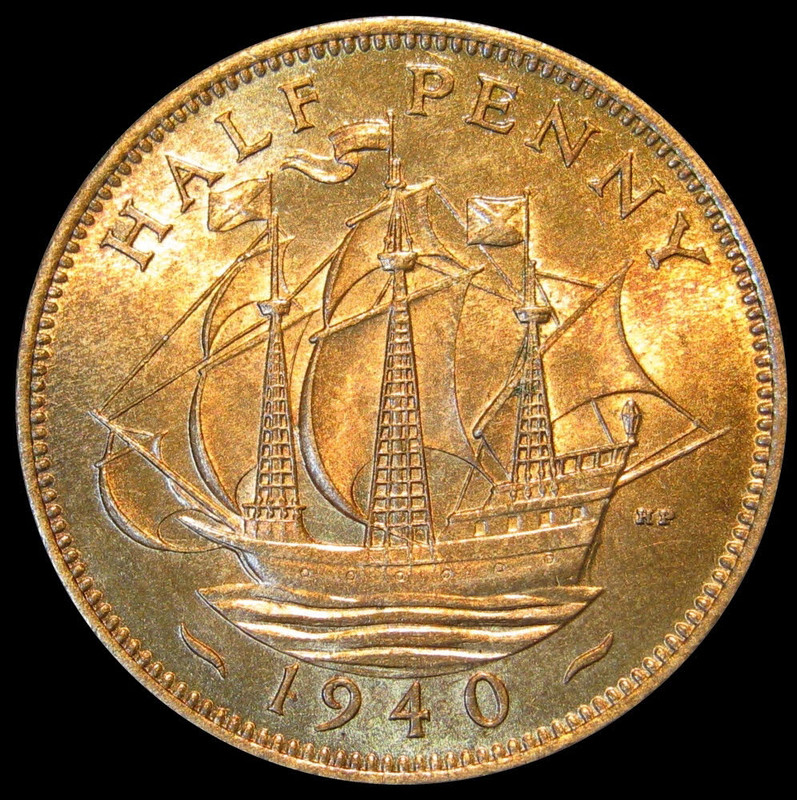
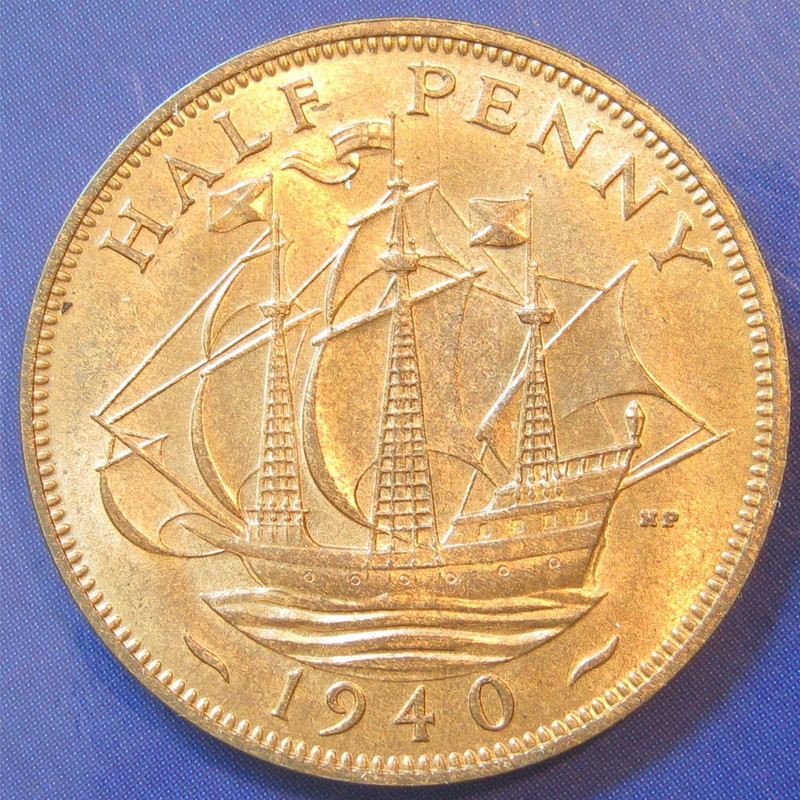
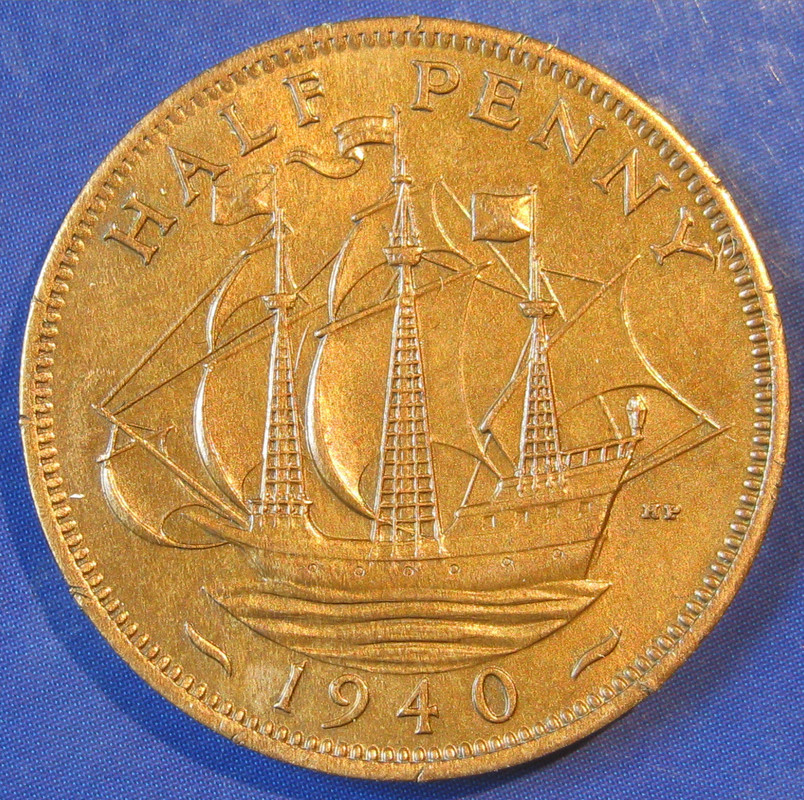
Design — The obverse carries the portrait of George VI by Thomas Humphrey Paget throughout the series. The reverse depicts the Golden Hind, the galleon associated with Sir Francis Drake, in a design first introduced on the halfpenny in 1937 under this reign. The reverse remained unchanged for the entire series.
1949 Legend Change — Following Indian independence, IND IMP (Indiae Imperator / Imperatrix) was removed from the royal style across all denominations from 1949. On the halfpenny, this required only a revision to the obverse legend spacing.
Key Dates — The 1938 halfpenny follows the characteristic "second date" pattern and tends to be scarcer in high grade than surrounding dates. The 1951 and 1952 dates, struck in the final years of the reign, are also worth noting for condition collectors — struck in smaller quantities and not always carefully preserved at the time.
George VI Halfpennies
 1937
1937
 1938
1938
 1939
1939
 1940 1+D
 1940 1+E
 1940 1+F
 1941
1941
 1942
1942
 1943
1943
 1944
1944
 1945
1945
 1946
1946
 1947
1947
 1948
1948
 1949
1949
 1950
1950
 1951
1951
 1952
1952
Specifications
| Years Issued | 1937–1952 |
| Diameter | 25.4 mm |
| Weight | 5.67 g |
| Edge | Plain |
| Alloy | Cu:95.5%, Sn:3%, Zn:1.5% |
| Obverse Designer | Thomas Humphrey Paget |
| Reverse Designer | Thomas Humphrey Paget |
Year-by-Year Reference
1937
Reverse A
| 1937 Halfpenny |
|---|
| Obverse | Reverse |
|
|

|
1938
Reverse B
| 1938 Halfpenny |
|---|
| Obverse | Reverse |
|
|

|
1939
Reverse C
| 1939 Halfpenny |
|---|
| Obverse | Reverse |
|
|

|
1940
| 1940 Halfpenny Reverse D |
|---|
| Obverse | Reverse D |
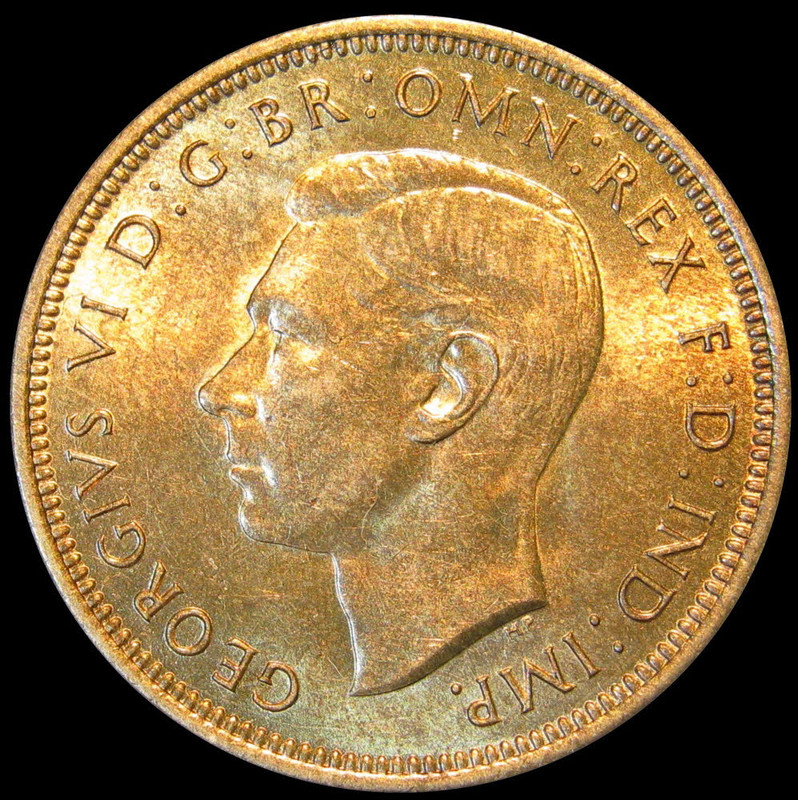
|
|
Scarcest
|
| 1940 Halfpenny Reverse E |
|---|
| Obverse | Reverse E |
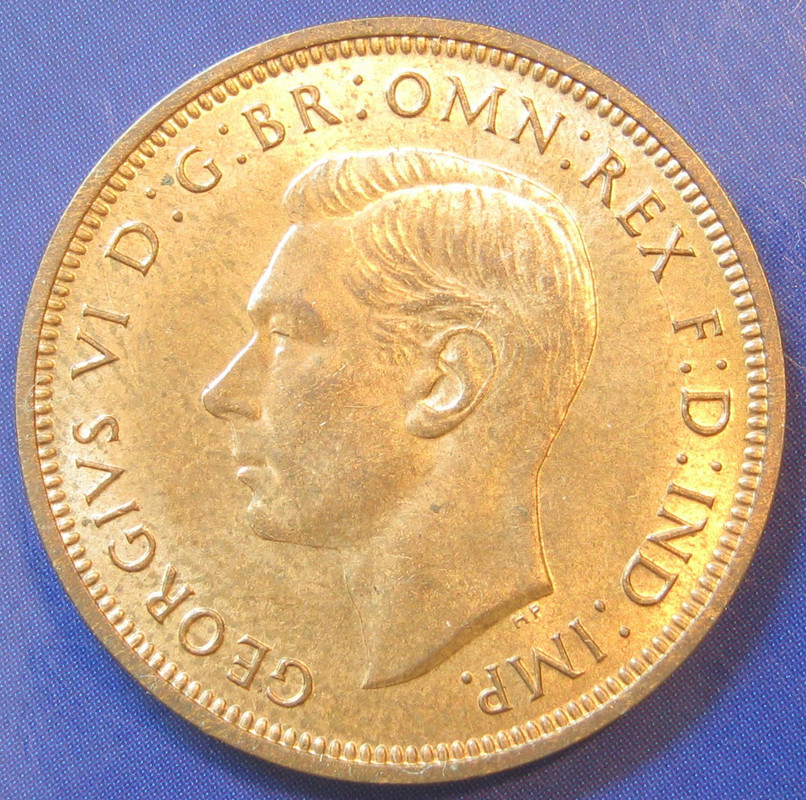
|
|
|
| 1940 Halfpenny Reverse F |
|---|
| Obverse | Reverse F |
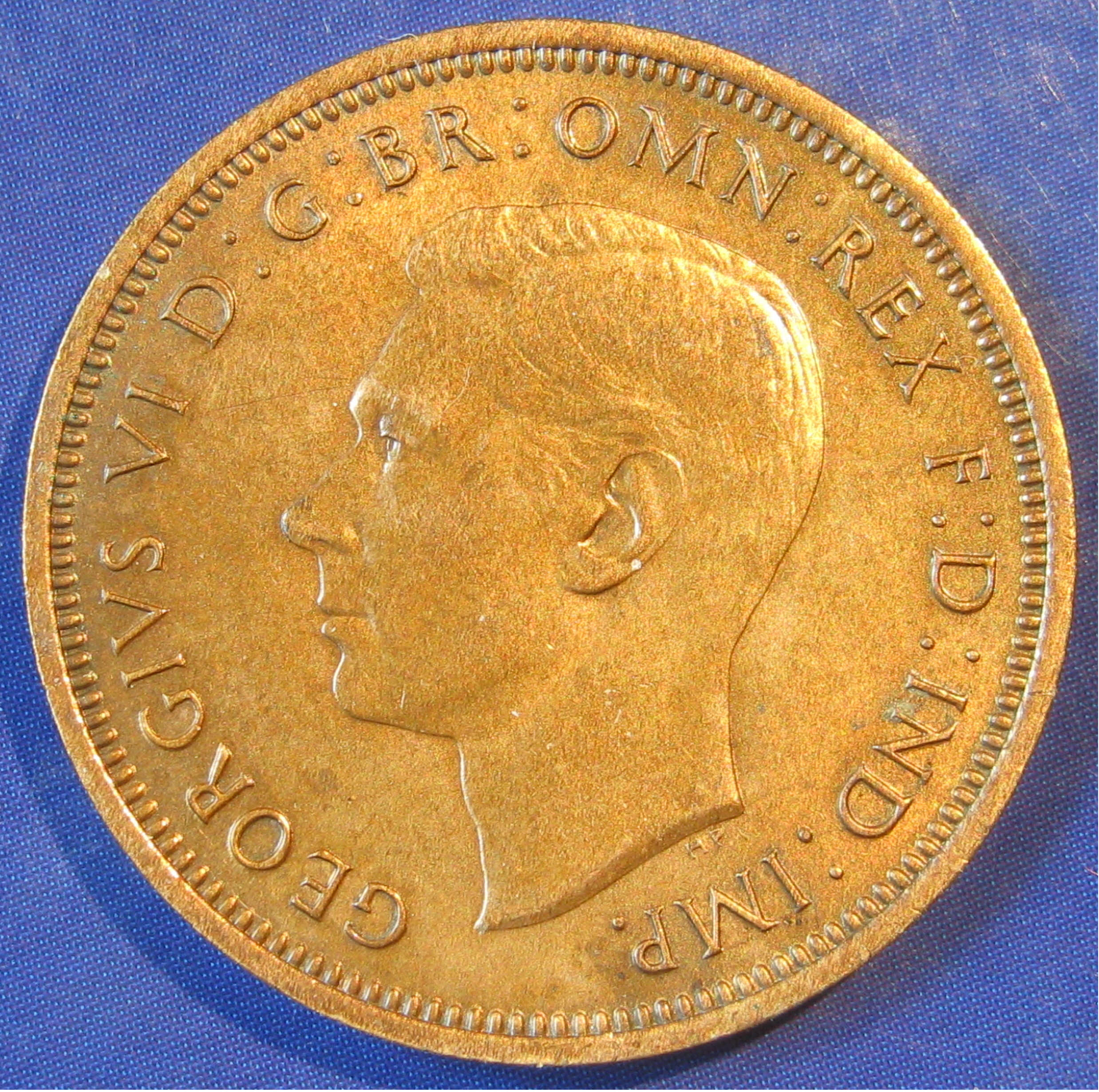
|
|
Commonest
|
1941
Reverse G
| 1941 Halfpenny |
|---|
| Obverse | Reverse |
|
|

|
1942
Reverse H
| 1942 Halfpenny |
|---|
| Obverse | Reverse |
|
|

|
1943
Reverse I
| 1943 Halfpenny |
|---|
| Obverse | Reverse |
|
|

|
1944
Reverse J
| 1944 Halfpenny |
|---|
| Obverse | Reverse |
|
|

|
1945
Reverse K
| 1945 Halfpenny |
|---|
| Obverse | Reverse |
|
|

|
1946
Reverse L
| 1946 Halfpenny |
|---|
| Obverse | Reverse |
|
|

|
1947
Reverse M
| 1947 Halfpenny |
|---|
| Obverse | Reverse |
|
|

|
1948
Reverse N
| 1948 Halfpenny |
|---|
| Obverse | Reverse |
|
|

|
1949
In common with all George VI denominations, and as a result of Indian independence, IND:IMP is omitted from 1949 onwards. Sometimes this required a design change, but on the Halfpenny, only the obverse inscription was altered.
Reverse O
| 1949 Halfpenny |
|---|
| Obverse | Reverse |
|
|

|
1950
Reverse O
| 1950 Halfpenny |
|---|
| Obverse | Reverse |
|
|

|
1951
Reverse O
| 1951 Halfpenny |
|---|
| Obverse | Reverse |
|
|

|
1952
Reverse P
| 1952 Halfpenny |
|---|
| Obverse | Reverse |
|
|

|