
Collectors Guide
Elizabeth II Halfpennies
The Elizabeth II halfpenny (1953–1967) forms part of British bronze coinage and features the traditional Golden Hind reverse design. Issued annually from the Coronation year through to the eve of decimalisation, the series includes notable varieties and increasing scarcity in higher grades. This guide provides a detailed reference to Elizabeth II halfpennies, including specifications, types and collecting insights.
Introduction
The Elizabeth II Halfpenny was struck from 1953 to 1967 in bronze, with a proof-only issue in 1970 and is one of the most commonly encountered denominations of the reign in circulated grades — yet genuinely elusive in true mint state for many dates. This page provides an overview of the Elizabeth II Halfpenny series, including obverse varieties, design details, and year-by-year reference images.
Like the penny and farthing, the halfpenny carries a traditional reverse design with deep roots in British coinage history. The series ran continuously from the Coronation year to the eve of decimalisation, with annual issues and no significant design modifications.
- 1953 – Two obverses recorded; most high-grade survivors are Obverse 1 ex plastic set.
- 1954–1967 – Annual production; condition rarity is the primary collecting challenge for earlier dates.
Collectors often seek out the 1953 for its varieties, while later issues are more common in high grade. A more interesting series than it is often given credit for. Microvarieties exist for 1953 and 1954, and the four varieties of 1956 halfpenny range from Very Common to Rare. 1957 Calm Sea coins are easy enough in low grade but high grade examples are quite sought after.
Coinage Details
Design — The obverse throughout the series carries the portrait of Queen Elizabeth II by Mary Gillick. The reverse continues the long-established depiction of the Golden Hind, the galleon associated with Sir Francis Drake's circumnavigation of the globe. The image had been used on British halfpennies since 1937 and remained unchanged for the Elizabeth II series.
1953 — Two obverses are recorded for the Coronation halfpenny, consistent with the pattern across the other denominations. Obverse 2 pieces in high grade are scarcer; the bulk of surviving uncirculated examples originate from the plastic presentation sets of that year.
1954–1967 — Annual production continued without design revision. The halfpenny was withdrawn at decimalisation in February 1971, having no equivalent in the new decimal system.
Elizabeth II Halfpenny Issues
 1953 Halfpenny 1+A
 1953 Halfpenny 2+A
 1954 Halfpenny 3+A
 1954 Halfpenny 3+B
 1955
1955
 1956 Halfpenny 3+C
 1956 Halfpenny 3+D
 1956 Halfpenny 4+C
 1956 Halfpenny 4+D
 1957 Calm Sea
 1957 Rough Sea
 1958
1958
 1959
1959
 1960
1960
 1962
1962
 1963
1963
 1964
1964
 1965
1965
 1966
1966
 1967 Halfpenny 3+J
 1967 Halfpenny 4+J
Specifications
| Years Issued | 1953–1967 | |
| Diameter | 25.4 mm | |
| Weight | 5.67 g | |
| Edge | Plain | |
| Alloy | 1953 to 1956 - Cu:95.5%, Sn:3%, Zn:1.5% | 1957 to 1965 - Cu:97%, Sn:0.5%, Zn:2.5% |
| Obverse Designer | Mary Gillick | |
| Reverse Designer | Thomas Humphrey Paget |
Year-by-Year Reference
1953
Obverse 1 was originally the scarcer of the two 1953 coins, as it was only found in the plastic sets, and 1.3 million of those were issued, compared to the 8.9 million Obverse 2s. As circulation took its toll, and as more plastic sets were split, Obverse 1 gradually became commoner in high grade. It is now quite unusual to find an Uncirculated Obverse 2. Not Rare, by any means, but unusual.
| 1953 Halfpenny Varieties |
|---|
|
Obverse 1
|
 |
|
Obverse 2
|
 |
1954
Freeman suggests Reverse B is slightly scarcer. My own findings indicate that it might be a bit more than slightly.
| 1954 Halfpenny Varieties |
|---|
|
Reverse A
|
 |
|
Reverse B
|
 |
1955
| 1955 Halfpenny |
|---|
| Obverse | Reverse |

|
|
1956
Crossover mule consisting of two obverses and two reverses. By far the commonest is 3+C – any other combination is worth snapping up in anything vaguely approaching VF.
I cannot show a picture of a 4+C (F.474), because I have never had one. That's got to tell you something. Freeman rates them as R12 (1000-2000 extant), and Sealy's addition to Peck rates them as VR. The pictures do show Obverse 4 and Reverse C though, so you can see what you are looking for. If you find one, let me know. I might buy it from you.
|
3+C D of DEI between beads I of DEI nearly at a bead L of HALF between beads F.471 (C10) Excessively Common |
 |
|
3+D D of DEI between beads I of DEI nearly at a bead L of HALF at a bead F.473 (R5) Rare |
 |
|
4+D D of DEI at a bead I of DEI between beads L of HALF at a bead F.475 (R3) Very Scarce |
 |
1957
Note that halfpennies prior to 1957 are Calm Sea, and those after display the Rough Sea. The vast majority of 1957s are the later variant. There are a range of sub-varieties of the Calm Sea coin, which are beyond the scope of this reference. Groom details them nicely.
|
Calm Sea Early 1957 obverse/reverse design |
 |
|
Rough Sea Later 1957 obverse/reverse design |
 |
1958
There are a host of tiny variations of 1958 halfpenny, also beyond my abilities to distinguish, and thus out of scope. Freeman details them, Peck touches upon them, but David Groom does them properly.
| 1958 Halfpenny |
|---|
| Obverse | Reverse |

|
|
1959
| 1959 Halfpenny |
|---|
| Obverse | Reverse |
|
|

|
1960
| 1960 Halfpenny |
|---|
| Obverse | Reverse |

|
|
1961
No halfpenny was released in 1961.
1962
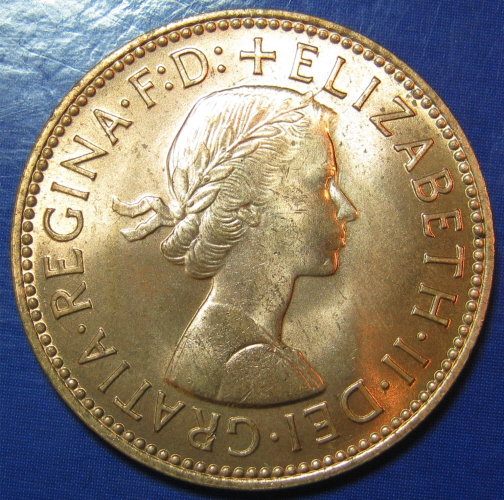
Note the slight alloy change – from this point the metal mix is 97% copper, 0.5% tin, 2.5% zinc. The bronze coinage prior to this consisted of 95.5% copper, 3% tin, 1.5% zinc.
| 1962 Halfpenny |
|---|
| Obverse | Reverse |
|
|
1963
| 1963 Halfpenny |
|---|
| Obverse | Reverse |

|
|
1964
| 1964 Halfpenny |
|---|
| Obverse | Reverse |

|
|
1965
| 1965 Halfpenny |
|---|
| Obverse | Reverse |

|
|
1966
| 1966 Halfpenny |
|---|
| Obverse | Reverse |

|
|
1967
The Wide Rim halfpenny is sometimes referred to as the 1968 halfpenny.
|
3+J Narrow rim I of GRATIA directly at a tooth  Common |
 |
|
4+J Wider rim I of GRATIA slightly to the left of a tooth  Scarcer |
 |
|
This photograph is Obverse 3 (left) joined to Obverse 4 (right), in order to show the difference in rim width. 
|
||