Collectors Guide
George V Pennies
The George V penny was issued from 1911 to 1936 and is one of the most recognisable bronze coins in British numismatics. Featuring Britannia on the reverse and multiple obverse portraits, the series includes several well-known varieties and key dates sought by collectors. This page provides a complete reference to George V pennies, including design details, specifications and collecting insights.
Introduction
The George V Penny was struck from 1911 to 1936 and is one of the most numismatically interesting series of all 20th century predecimal coins. This page provides a year-by-year reference for the George V Penny series, including obverse and reverse varieties, mint marks, design changes, and notes on the key dates and condition rarities.
Straightforward single-issue types are firmly in the minority. The series is rich in variety from the very first year and repays careful examination throughout. Some of the more exotic pieces — most notably the 1933 Penny — have been deliberately omitted, as they are coins that the collector is unlikely to encounter in the course of normal collecting. This is intended as a practical guide, after all.
- 1911 – Two obverse types (Flat Neck and the rare Hollow Neck / Gouby X, with under 50 known specimens).
- 1912–1919 – Auxiliary mint issues from Birmingham (H) and Kings Norton (KN) join the London series in 1912, 1918, and 1919; all are condition rarities in top grade. Recessed Ear varieties appear in 1915 and 1916.
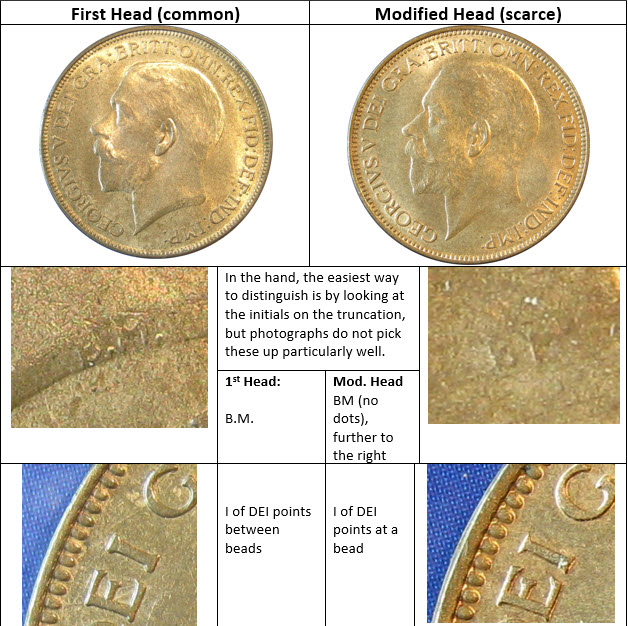
- 1920–1927 – Alloy changes in the early 1920s; crossover obverse varieties in 1920–1921. The Modified Head is introduced in 1926 (approximately 1 in 40 pennies of that year).
- 1928–1936 – The small head effigy, introduced to combat ghosting, carries the series to its close. A rare reverse variety is recorded for 1922.
Coinage Details
1911 — The Hollow Neck variety (Gouby X, Obverse 1*), discovered by Michael Gouby and classified in the new Freeman edition, is one of the great rarities of the bronze series. Fewer than 50 specimens are currently known. The Flat Neck is the standard type. Both are identifiable by the pointing of the I of BRITT and I of IMP relative to the border beads.
1912–1919 — The Birmingham Mint (H mintmark) produced a significant quantity of bronze blanks and struck pennies in 1912 and 1918–1919; the Kings Norton Metal Company (KN mintmark) also struck pennies in 1918–1919. In both cases, as well-known varieties, a higher proportion were rescued from the decimalisation melting pot than standard London pennies, making them commoner now in lower grades than they were at their natural circulating level — while remaining very difficult indeed in top condition. The 1918 KN also includes a Bird's Foot die-flaw variety recorded by Peck.
1920–1927 — Two crossover obverse varieties exist for 1920 and 1921. The 1926 Modified Head Penny is one of the most important varieties of the reign, accounting for approximately 2.4% of the 1926 issue — roughly 1 in every 40 pennies. A rare reverse pairing also exists for 1922, sometimes called the "1922 with 1927 reverse," known from only a handful of specimens.
1928–1936 — The small head, introduced in 1928, represents the Mint's most effective solution to the ghosting problem and remained in use through to the final year of the reign.
George V Pennies
 1911 – Flat neck
 1911 – Hollow neck
 1912 – London mint
 1912 – Birmingham mint
 1913 – 1+A
 1913 – 1+B
 1913 – 2+B (Crossover mule)
 1914
1914
 1915 – Normal ear
 1915 – Recessed ear
 1916 – Normal ear
 1916 – Recessed ear
 1917
1917
 1918 – London mint
 1918 – H
 1918 – KN
 1918 – KN Birds foot
 1919 – London mint
 1919 – H
 1919 – KN
 1920
1920
 1921 – Obverse 2
 1921 – Obverse 3
 1922
1922
 1926 – First Effigy
 1926 – Modified Effigy
 1927
1927
 1928
1928
 1929
1929
 1930
1930
 1931
1931
 1932
1932
 1934
1934
 1935
1935
 1936
1936
Specifications
| Years Issued | 1911–1936 |
| Diameter | 30.86 mm |
| Weight | 9.45 g |
| Edge | Plain |
| Alloy |
Upto 1922: 95% Copper, 4% Tin, 1% Zinc From 1923: 95.5% Copper, 3% Tin, 1.5% Zinc |
| Obverse Designer | Sir Bertram Mackennal |
| Reverse Designer | Leonard Charles Wyon |
Year-by-Year Reference
1911
All 1911 denominations have two obverse types:
- ■ Flat Neck
- ■ Hollow Neck
The rare Hollow Neck variety has a distinct diagonal indentation toward the back of the neck, roughly following the position of the tendon, whereas the King’s neck on the commoner type is sculpted smoothly. The scarce Hollow Neck is often referred to as Gouby X and is classified as Obverse 1* in the new Freeman edition, with under 50 known specimens.
| 1911 Penny Varieties |
|---|
| Obverse: Flat Neck | Reverse A |
|
|

|
With a little wear to the truncation, the hollow neck really stands out. Instantly recognisable when you know what you're looking for, but there are pointings to confirm as well:
|
|
| Obverse: Hollow Neck (Gouby X) | Reverse A |
|
|

|

1912
Minted at Tower Hill in London (no mintmark), and by The Mint, Birmingham (successors to Ralph Heaton and Sons), indicated by the small H mintmark in the left of the exergue. The Birmingham Mint also produced a large number of bronze blanks for farthings, halfpennies, and pennies from 1912 to 1919.
- ■ 1912 – London Mint
- ■ 1912 H – Birmingham Mint
| 1912 Penny Varieties |
|---|
| Obverse: London Mint | Reverse |

|
|
| Obverse: Birmingham Mint (H) | Reverse |

|
|
Difficult to find at this level – the vast majority of H and KN pennies are really much of a muchness. The 1912 H in particular is much more common than it was while circulating at its natural level; as a well-known variety, a higher proportion of these were rescued from the decimalisation melting pot than London Mint 1912 pennies, so they are commoner now than they have ever been.
1913
Another classic crossover mule. 1913 began with 1+A and finished with 2+B. In between, probably by mistake, a few 1+B and 2+A coins slipped through.
Another classic crossover mule. 1913 began with 1+A and finished with 2+B. In between, probably by mistake, a few 1+B and 2+A coins slipped through.
Obverses
- ■ Obverse 1 – Use the spacing of the A in GRA and B in BRITT to distinguish
- ■ Obverse 2 – Use the spacing of the A in GRA and B in BRITT to distinguish
Reverses
- ■ Reverse A – Use the pointing of the first 1 in the date to distinguish
- ■ Reverse B – Use the pointing of the first 1 in the date to distinguish
Possible Combinations
- ■ 1 + A
- ■ 1 + B
- ■ 2 + A
- ■ 2 + B
| Identification of Varieties |
|---|
| Obverse 1 | Reverse A |

|

|
| Obverse 1 | Reverse B |
|
|

|
| 1913 Penny Varieties |
|---|
| Obverse 1 | Reverse A |

|
|
| Freeman 174 – Common (21.8%) | |
| Obverse 1 | Reverse B |

|
|
| Freeman 175 – Scarce (2.6%) | |
| Obverse 2 | Reverse B |

|
|
| Freeman 177 – Common (74.2%) | |
1914
A relatively straightforward year for the penny series, struck with the standard obverse and reverse pairing.
| 1914 Penny |
|---|
| Obverse | Reverse |

|
|
1915
1915 pennies come in two main varieties:
- ■ The standard Normal Ear
- ■ The scarcer Recessed Ear
| 1915 Penny Varieties |
|---|
| Obverse: Normal Ear | Reverse |
|
|

|
|
This is an interesting variety. It is likely that the Mint was attempting to reduce ghosting by recessing the ear. All Recessed Ear coins have a broken border tooth above the colon after BRITT. Examples from 1915 are scarcer than 1916 recessed ears. |
|
| Obverse: Recessed Ear | Reverse |
|
|

|
1916
1916 pennies also come in two main varieties:
- ■ The standard Normal Ear
- ■ The scarcer Recessed Ear
| 1916 Penny Varieties |
|---|
| Obverse: Normal Ear | Reverse |
|
|

|
|
This is an interesting variety. It is likely that the Mint was attempting to reduce ghosting by recessing the ear. All Recessed Ear coins have a broken border tooth above the colon after BRITT. Examples from 1915 are scarcer than 1916 recessed ears. |
|
| Obverse: Recessed Ear | Reverse |
|
|

|
1917
Another straightforward year in the series, featuring the standard obverse and reverse pairing without major varieties.
| 1917 Penny |
|---|
| Reverse | Obverse |
|
|

|
1918
Three Mints took part in the production of pennies in 1918:
- ■ Tower Hill Mint, London (no mintmark)
- ■ Ralph Heaton & Sons, Birmingham (H mintmark)
- ■ The Kings Norton Metal Company, Birmingham (KN mintmark)
In both 1918 and 1919, the H and KN pennies suffered from the same “rescue rate” phenomenon as the 1912 H penny. As a result, they are very common in low circulated grades, but in top grade they are extraordinarily difficult and highly collectable — textbook examples of condition rarities.
| 1918 Penny Varieties |
|---|
| London (no mintmark) | Reverse |
|
|

|
| Ralph Heaton (H mintmark) | Reverse |
|
|

|
| Kings Norton (KN mintmark) | Reverse |
|
|

|
|
Some 1918 KN pennies display a distinctive die flaw below the ear, shaped like a bird’s foot. This “Bird’s Foot” flaw is recorded in Peck and is shown in the images below. |
|
| KN “Bird’s Foot” flaw | Reverse |

|

|
1919
Three Mints took part in the production of pennies in 1919:
- ■ Tower Hill Mint, London (no mintmark)
- ■ Ralph Heaton & Sons, Birmingham (H mintmark)
- ■ The Kings Norton Metal Company, Birmingham (KN mintmark)
In both 1918 and 1919, the H and KN pennies suffered from the same “rescue rate” phenomenon as the 1912 H penny. As a result, they are very common in low circulated grades, but in top grade they are extraordinarily difficult and highly collectable — textbook examples of condition rarities.
| 1919 Penny Varieties |
|---|
| London (no mintmark) | Reverse |
|
|

|
| Ralph Heaton (H mintmark) | Reverse |
|
|

|
| Kings Norton (KN mintmark) | Reverse |
|
|

|
1920
Obverse 2 is the normal type for 1920, and so far, Obverse 3 is believed to be unique for 1920 — which makes it a very exciting find if another turns up!
Both Obverses are used in 1921, so there is an easy way to familiarise yourself with the two types: go through your 1921 pennies and identify the Obverse 2s and Obverse 3s. You can look at all the photographs you like, but there really is no substitute for examining coins in hand when learning varieties of this subtlety.
Obverses
- ■ Obverse 2 – Lower colon dot is almost in contact with the letters on either side
- ■ Obverse 3 – A and B are further apart, leaving a clear gap between the lower colon dot and the letters
| Identification of Obverses |
|---|
| Obverse 2 | Obverse 3 |

|

|
| 1920 Penny Varieties |
|---|
| Obverse | Reverse |
|
|

|
1921
According to Court, 37.3% of 1921 pennies are Obverse 2, and I have found that to be more or less the case. Roughly twice as many Obv 3 as Obv 2 coins have passed through my hands.
Obverses
- ■ Obverse 2 – Lower colon dot is almost in contact with the letters on either side
- ■ Obverse 3 – A and B are further apart, leaving a clear gap between the lower colon dot and the letters
| 1921 Penny Varieties |
|---|
| 1921 – Obverse 2 + Reverse B | Obverse 2 Detail |

|

|
| 1921 – Obverse 3 + Reverse B | Obverse 3 Detail |

|
|
1922
A very rare variety of the 1922 penny does exist, sometimes catalogued (inaccurately) as “1922 with 1927 reverse.”
Only a handful of these are known, but as with all relatively recent discoveries, there will almost certainly be more out there — so don’t stop checking for this one. I use the trident as a quick check on any 1922 pennies that I come across, but see how many other variations between the two reverses you can spot — it’s like a game of “spot the difference.”
There are some pennis which have a dot on the central prong of the trident.
| 1922 Penny Varieties |
|---|
| Standard 1922 Penny | Reverse |
|
|

|
|
Rare Variety: 1922 with so-called “1927 reverse.”
|
|

|
|
1926
The 1926 Modified Head Penny makes up approximately 2.4% of the 1926 issue, according to Court’s survey — equivalent to about 1 in every 40 pennies — so it’s worth checking for.
This is one of those varieties that you learn to spot quickly, but here we’ll highlight the key diagnostics. The design change was part of a series of attempts to reduce the “ghosting” effect seen on many George V coins, where a faint inverse impression of the bust is visible on the reverse.
| 1926 Penny Effigies |
|---|
| First (Common) Effigy | Modified (Scarce) Effigy |

|

|
1927
All 1927 pennies feature the Modified Head, providing a clean and consistent design across the year.
| 1927 Penny |
|---|
| Obverse | Reverse |

|
|
1928
From 1928 a new smaller effigy was adopted, representing the Mint’s most effective attempt to reduce ghosting on George V coinage.
| 1928 Penny |
|---|
| Obverse | Reverse |

|
|
1929
A regular issue with no major varieties, the 1929 penny continues with the small head effigy.
| 1929 Penny |
|---|
| Obverse | Reverse |

|
|
1930
Another straightforward year in the series, with the small head obverse design and no notable varieties.
| 1930 Penny |
|---|
| Obverse | Reverse |

|
|
1931
The 1931 penny follows the same style as the surrounding years, with no distinct varieties.
| 1931 Penny |
|---|
| Obverse | Reverse |

|
|
1932
A typical issue year with no special varieties, continuing with the small head effigy.
| 1932 Penny |
|---|
| Obverse | Reverse |

|
|
1933
1933 pennies were not struck for circulation and exist only in a very small number of ceremonial and specimen issues, making them one of the rarest British coins.
1934
A low mintage year, but with no major varieties recorded.
| 1934 Penny |
|---|
| Obverse | Reverse |

|
|
1935
1935 pennies continue with the standard small head effigy and show no distinct varieties.
| 1935 Penny |
|---|
| Obverse | Reverse |

|
|
1936
The final George V penny, issued in the year of the King’s death. A fitting end to the series, though not a scarce date in circulation.
| 1936 Penny |
|---|
| Obverse | Reverse |

|
|