Introduction
The Threepence of George V was struck throughout most of the reign and represents the smallest silver denomination of the circulating coinage.
Although modest in size, the series reflects several of the wider developments that affected British silver coinage during the early twentieth century,
including the reduction in silver content in 1920 and later modifications to both the portrait of the King and the reverse design.
Four distinct coinages can be identified, reflecting the debasement of silver in 1920, the introduction of a modified portrait of George V later in the reign,
and a redesigned reverse introduced in 1927.
- 1st Coinage (1911–1919) – Struck in sterling silver (.925) and introduced the new reign with the traditional crowned numeral III reverse.
- 2nd Coinage (1920–1926) – Retained the same design but used the reduced .500 silver alloy introduced after the First World War.
- 3rd Coinage (1926–1927) – Introduced a modified portrait of George V, creating a short transitional issue.
- 4th Coinage (1927–1936) – Introduced a redesigned reverse by George Kruger Gray while continuing the later portrait and .500 silver alloy.
Coinage Details
1st Coinage (1911–1919) — The first coinage was struck in traditional sterling silver (.925) and introduced
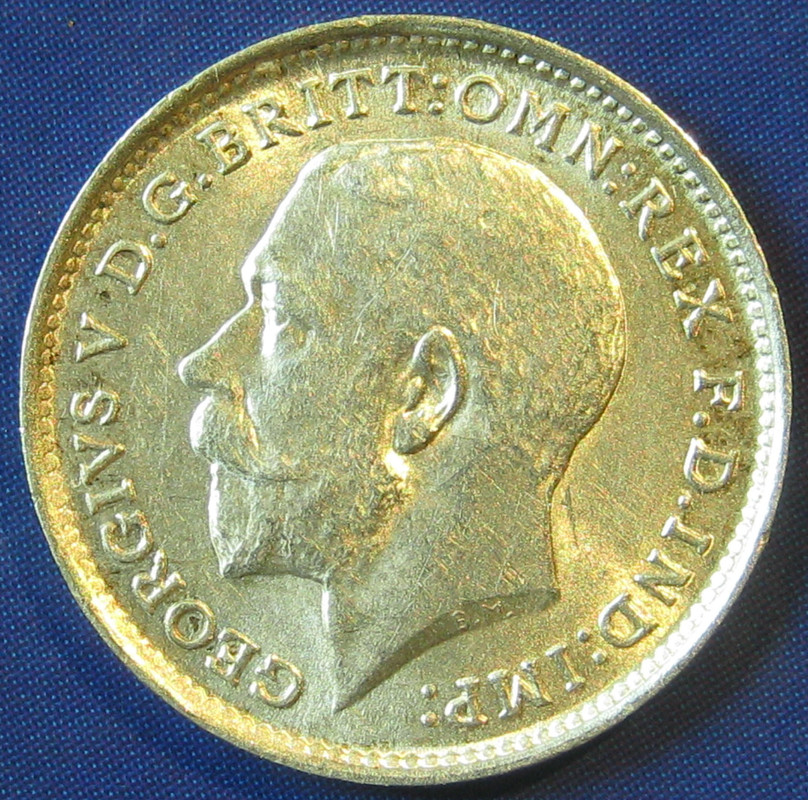
the effigy of George V by Sir Bertram Mackennal. The reverse retained the crowned numeral III design first used on
the Edward VII threepence. These early pieces represent the final circulating sterling-silver threepences before the
debasement of British silver coinage.
2nd Coinage (1920–1926) — In 1920, rising silver prices led to the reduction of the precious-metal content
of circulating coinage. From this point onward the threepence was struck in .500 fine silver, containing equal parts
silver and base metal. This change marks the second coinage, which retained the same basic design but used the new alloy.
3rd Coinage (1926–1927) — A further modification followed with the introduction of a revised portrait of
George V. This short transitional issue retained the debased silver alloy and the earlier crowned numeral reverse while
introducing subtle changes to the King’s effigy and legend.
A notable feature of the 1926–1927 coinage is the shortened obverse legend, with the titles
FID DEF IND IMP removed from the inscription. This change accompanied the introduction of the modified effigy
of George V and marks the transitional phase between the earlier and later designs of the reign.
4th Coinage (1927–1936) — The fourth and final coinage introduced a redesigned reverse by George Kruger Gray.
Although the familiar crowned numeral III motif was retained, the design was modernised with revised lettering and
a more balanced layout within the legend. This updated style remained in use for the remainder of the reign.
Overall, the George V threepence series reflects the wider economic and artistic developments of the early twentieth century—
particularly the reduction in silver content after the First World War and the broader modernisation of British coinage
during the later years of the reign.
Note:
- The reverse redesign introduced in 1927 applied only to the circulating silver threepence. The Maundy threepence retained its traditional design throughout the reign.
- No threepence was issued for circulation in 1923 and 1924.
- Only proof threepence pieces were issued in 1927.
- No threepence was issued for circulation in 1929.
George V Threepence
 1911 – Hollow Neck
 1911 – Flat Neck
 1911 – Reverse A
 1912
1912
 1913
1913
 1914 – Obverse 2
 1914 – Obverse 3
 1915
1915
 1916
1916
 1917
1917
 1918
1918
 1919
1919
 1920
1920
 1921
1921
 1922
1922
 1925
1925
 1926 – First Effigy
 1926 – Modified Effigy
 1928
1928
 1930
1930
 1931
1931
 1932
1932
 1933
1933
 1934
1934
 1935
1935
 1936
1936
Specifications
| Years Issued |
1911–1936 |
| Diameter |
16 mm |
| Weight |
1.41 g |
| Edge |
Milled |
| Alloy |
1911–1919: 92.5% silver, 7.5% copper
1920–1926:
- Ag 50%, Cu 40%, Ni 10%
- Ag 50%, Cu 45%, Mn 5%
- Ag 50%, Cu 50%
1927–1936: Ag 50%, Cu 40%, Ni 5%, Zn 5%
|
| Obverse Designer |
Sir Bertram Mackennal |
| Reverse Designers |
1911–1926: George William de Saulles
1927–1936: George Kruger Gray
|
Year-by-Year Reference
1912
The years after a Coronation are always scarce in high grade - 1903, 1912, 1938, 1954
Because they weren't new any more, people didn't hoard them.
| Obverse |
Reverse |
|
|
1913
Obverse 2, Reverse B – typical design for this year.
| Obverse 2: Standard |
Reverse B: Standard |

|
|
1914
Part way through 1914, in common with the farthing, a slightly different Obverse design was introduced.
Pointings are the easiest way to distinguish them.
Obverse 2 – Slightly Scarcer
Obverse 3 – More Commoner
-
■
Obverse 2 – I of GEORGIVS just right of a bead
-
■
Obverse 3 – I of GEORGIVS just left of a bead
|
1914 Threepence Varieties
|
| Obverse 2 |
Reverse B |
|
|

|
| Obverse 3 |
Reverse B |
|
|

|
1915
Obverse 3, Reverse B – standard design for this year.
| Obverse 3 |
Reverse B |

|
|
1916
Obverse 3, Reverse B – standard design for this year.
| Obverse 3 |
Reverse B |

|
|
1917
Obverse 3, Reverse B – standard design for this year.
| Obverse 3 |
Reverse B |

|
|
1918
Obverse 3, Reverse C – note the change in reverse type from previous years.
| Obverse 3 |
Reverse C |

|
|
1919
Obverse 3, Reverse B.
Keep an eye out for a rare 9/8 variety – the second "9" in the date is the key.
| Obverse 3 |
Reverse B |

|
|
1920
The composition of all the silver coins was debased in 1920 from 92.5% sterling silver to 50% silver.
Initially the alloy used was Ag 50%, Cu 40%, Ni 10%, but this was not found to be satisfactory, and consequently some coins from 1920 have manganese in their alloy.
Ag 50%, Cu 50% was tried briefly and found to be even worse, and finally Ag 50%, Cu 40%, Ni 5%, Zn 5% was settled on.
This alloy saw the coinage through to the final removal of silver in 1946.
Both sterling and 50% silver threepences have been found dated 1920, and those with better trained ears than I can tell from the ring which is which.
I can’t, and I was never that comfortable with dropping coins on a hard surface in order to listen to the ring, so this is a variety that I never attempted to include.
-
■
Ag 50%, Cu 40%, Ni 10%
-
■
Ag 50%, Cu 45%, Mn 5%
-
■
Ag 50%, Cu 50%
| Obverse 3 |
Reverse C |

|
|
1921
Scarce type with narrower "2" in the date.
| Obverse 3 |
Reverse B |

|
|
1922
-
■
Ag 50%, Cu 40%, Ni 10%
-
■
Ag 50%, Cu 45%, Mn 5%
-
■
Ag 50%, Cu 50%
| Obverse 3 |
Reverse B |

|
|
1923 - No 3p for this year.
1924 - No 3p for this year.
1925
Composition Ag 50% and Cu 50%.
| Obverse 3 |
Reverse B |

|
|
1927 - Proof Only
To mark the introduction of new reverse designs across the silver coinage, 15,000 limited edition Proof sets were issued in 1927.
Any threepence dated 1927 will be from one of these sets; they are highly collectable.
1928
From this point onwards, the alloy is Ag 50%, Cu 40%, Ni 5%, Zn 5%,
and the obverse and reverse designs remain unchanged.
1928 and 1930 silver threepences are noticeably scarcer than their neighbours.
-
■
Ag 50%, Cu 40%, Ni 5%, Zn 5%
| Obverse |
Reverse |

|
|
1929 - No coins bearing the date 1929 were issued.
1930
1928 and 1930 silver threepences are noticeably scarcer than their neighbours.
No coins bearing the date 1929 were issued.
| Obverse |
Reverse |

|
|
1931
| Obverse |
Reverse |

|
|
1932
| Obverse |
Reverse |

|
|
1933
| Obverse |
Reverse |

|
|
1934
| Obverse |
Reverse |

|
|
1935
| Obverse |
Reverse |

|
|
1936
| Obverse |
Reverse |

|
|
References
Attributions and variety identifications for the George V Halfcrown series are based principally on the standard published references listed below.
These works form the core framework for catalogue numbering, die classification, and comparative study.
- Coins of England and the United Kingdom
- ESC – English Silver Coinage
- Bull – English Silver Coinage since 1649
- Davies – British Silver Coins since 1816