Introduction
Edward VII farthings were minted from 1902 to 1910. These small copper coins feature the king’s portrait on the obverse and Britannia on the reverse. They are popular with collectors of low-denomination coins and exhibit a few minor varieties.
Edward VII farthings were struck at the Royal Mint in London. The obverse features a left-facing portrait of King Edward VII with the legend EDWARDVS VII REX IMPERATOR. The reverse shows Britannia seated, holding a trident and shield. Mintages vary by year, with 1902 and 1905 being the most commonly found.
A straightforward series, with no varieties. The mint darkening of farthings
to avoid confusion with the half-sovereign is very obvious, and very
attractive, in high grade examples.
1910 is slightly scarcer than the other dates, but they have all become
harder to find in top grade recently.
The Edward VII Farthing was struck from 1902 to 1910 in bronze, carrying the portrait of Edward VII by George William de Saulles on the obverse and the traditional seated Britannia reverse. The farthing is the smallest denomination of the reign and, while modest in face value, offers genuine collecting interest — particularly in the first year of issue, where the tidal changes seen on the penny and halfpenny have their own farthing parallel. This page provides an overview of the Edward VII Farthing series, including the 1902 and 1903 tidal notes, and year-by-year reference images.
Unlike the penny and halfpenny, the farthing adopted the High Tide reverse immediately in 1902 — there is no Low Tide 1902 farthing equivalent to its bronze siblings. However, the 1903 farthing is a notable exception: it briefly reverted to using the Low Tide Victorian reverse dies for a single year before the High Tide became the standard from 1904 onward.
Coinage Details
1902 — High Tide reverse only; no Low Tide variety recorded for the farthing in this year, unlike the penny and halfpenny.
1903 — Struck using the Low Tide Victorian reverse dies for a single year, before the High Tide reverse was fully adopted from 1904. This makes the 1903 farthing the only date in the Edwardian series to display the Low Tide reverse, and it is worth identifying when examining examples of this date.
1904–1910 — Annual High Tide issues throughout. The series is generally available in circulated grades; genuinely uncirculated examples from the middle years of the reign require more effort to locate and represent the real challenge for the condition collector.

 1902
1902
 1903
1903
 1904
1904
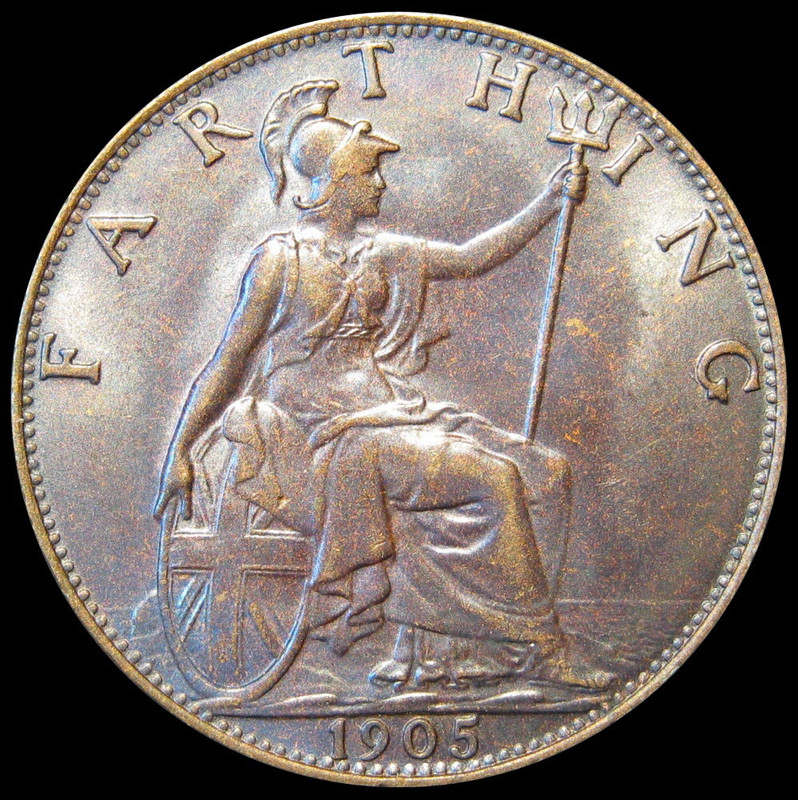 1905
1905
 1906
1906
 1907
1907
 1908
1908
 1909
1909
 1910
1910


