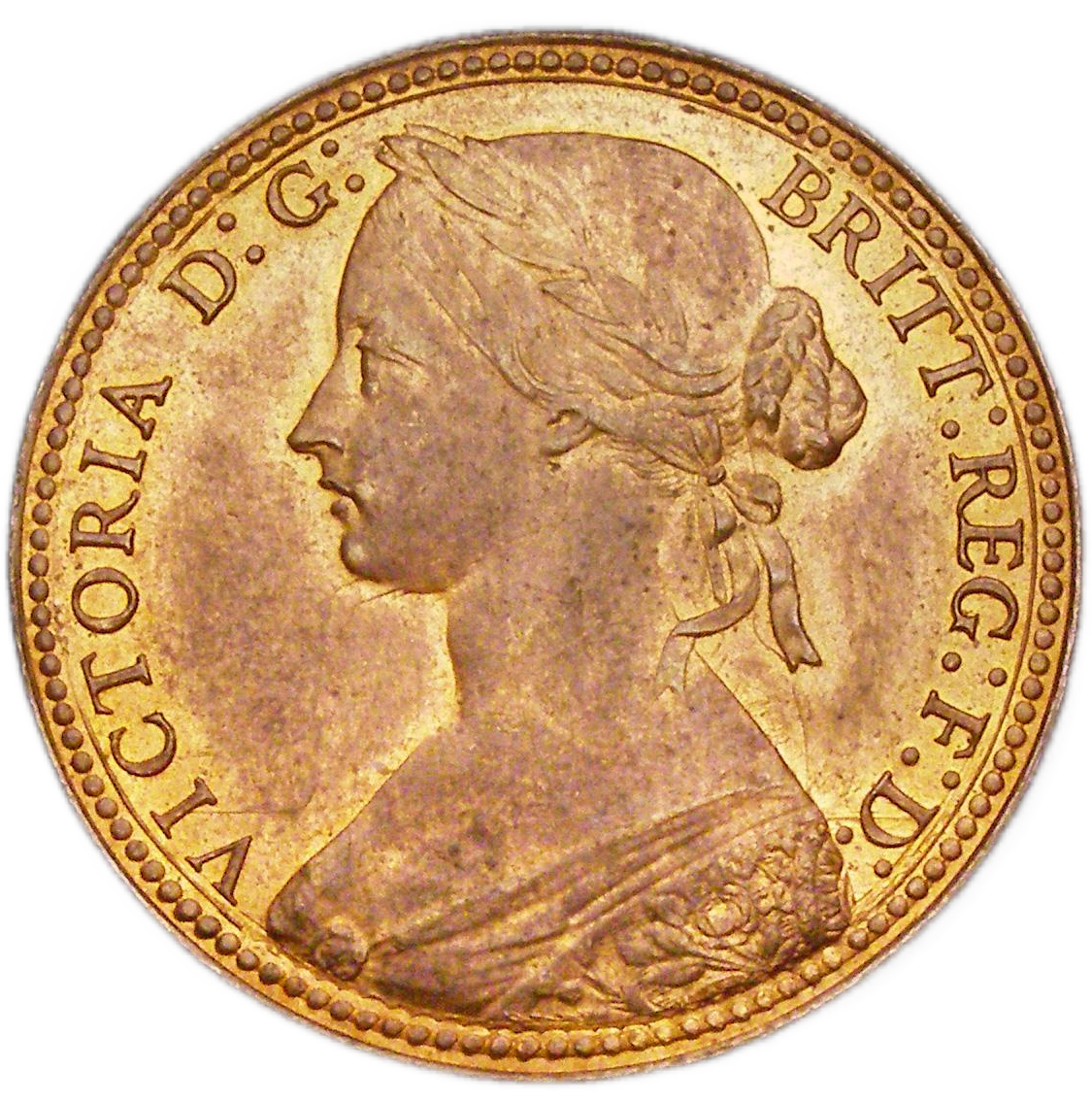
Reference: Freeman Victoria Bun-Head Penny Variety Guide

Victoria Bun Head Penny Varieties
1860 – 1894

A practical attribution guide to the bronze Bun Head penny series, based on Freeman’s obverse and reverse system.


How Freeman Classifies Bun Head Pennies

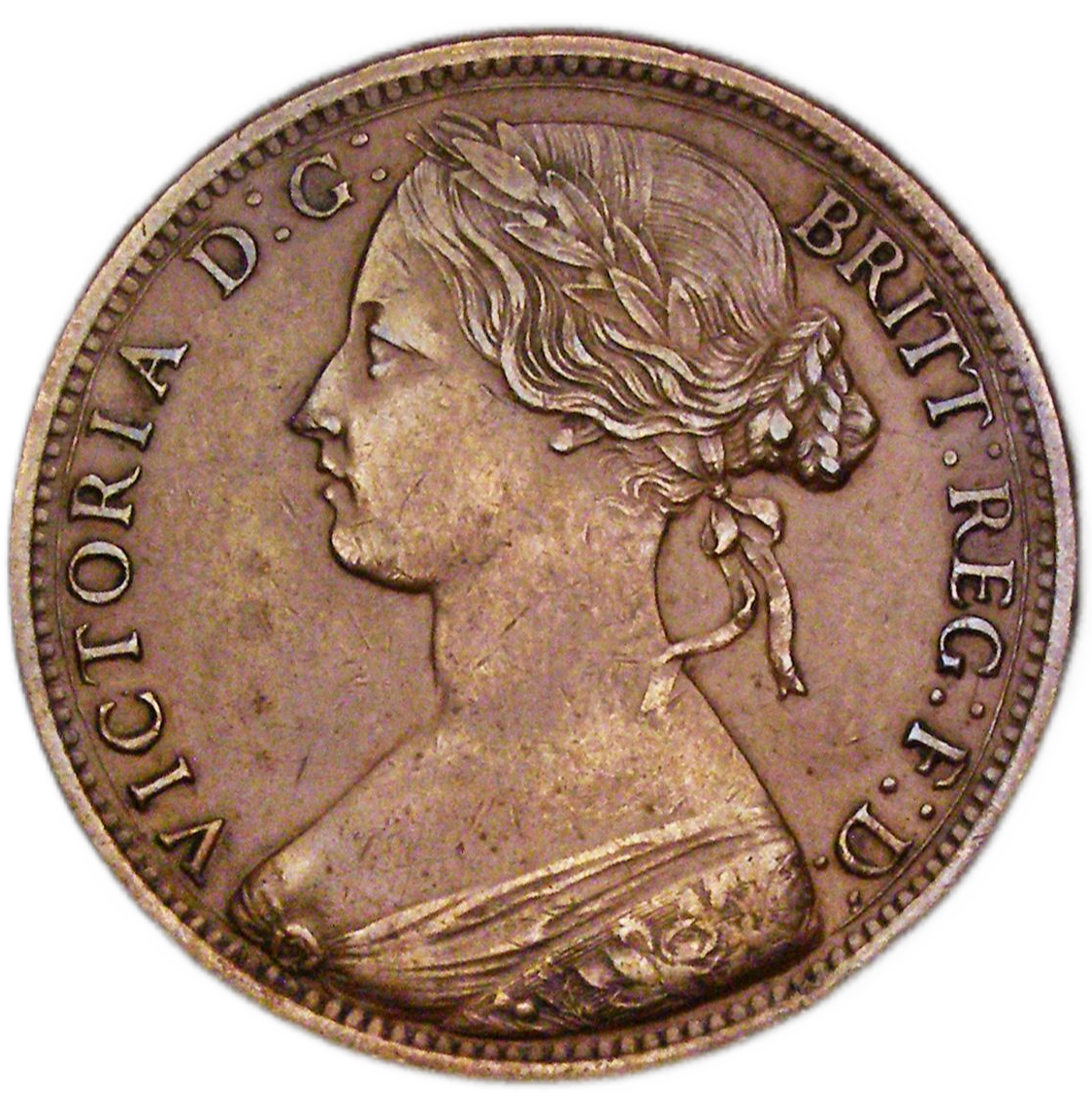
Freeman classifies the Bun Head penny by pairing an obverse type with a reverse type. The attribution is therefore not based on a single feature alone, but on the combination of Victoria’s portrait, the border, Britannia’s reverse design, and the date.

5-Second Attribution Guide

1. Check the Border

Beaded border usually points to early 1860.

Toothed border points to later 1860 and after.

2. Check the Obverse

Look for the eye shape, bust position, lettering style, and whether L.C. WYON is present below the bust.

3. Check the Reverse

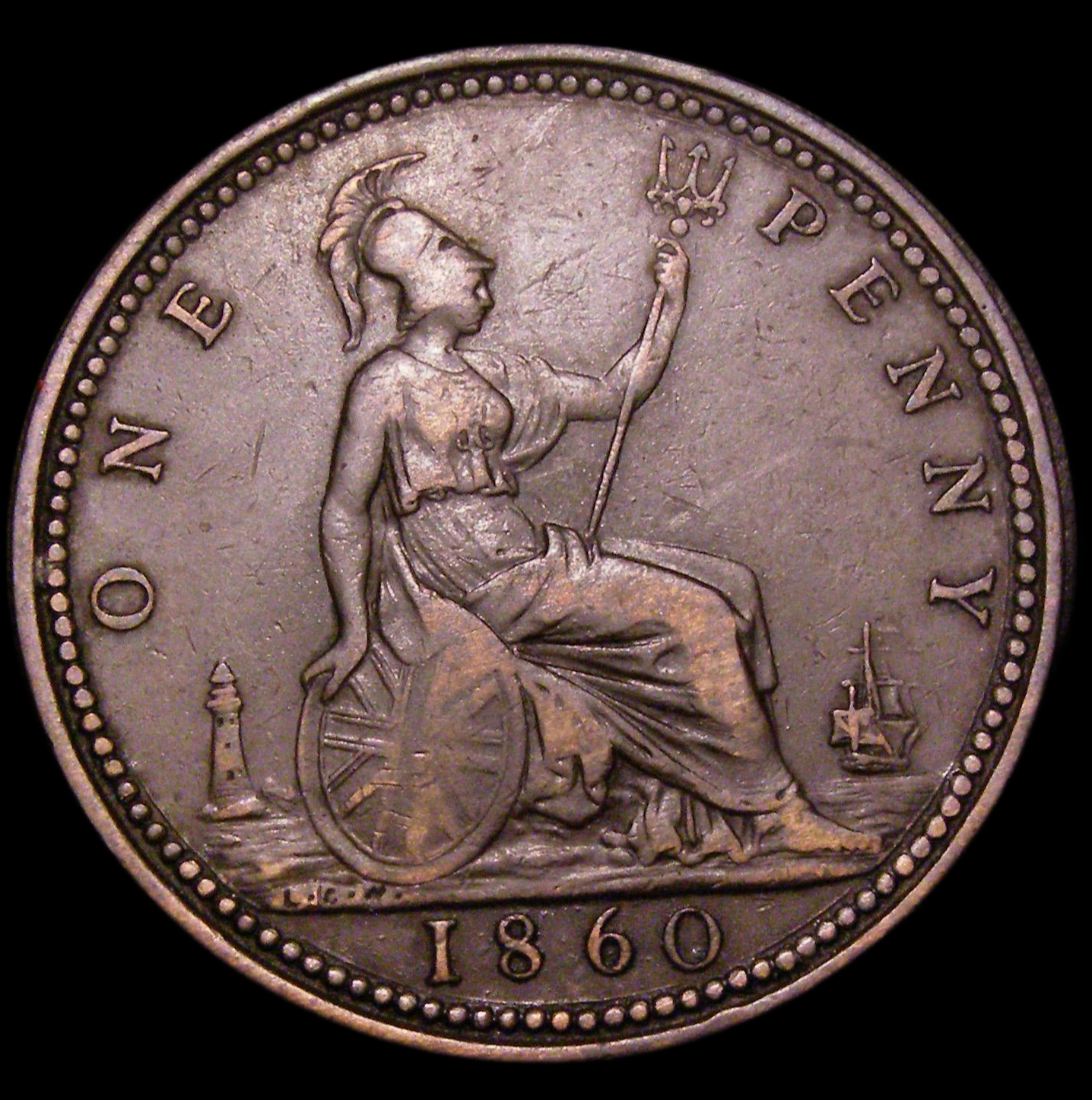
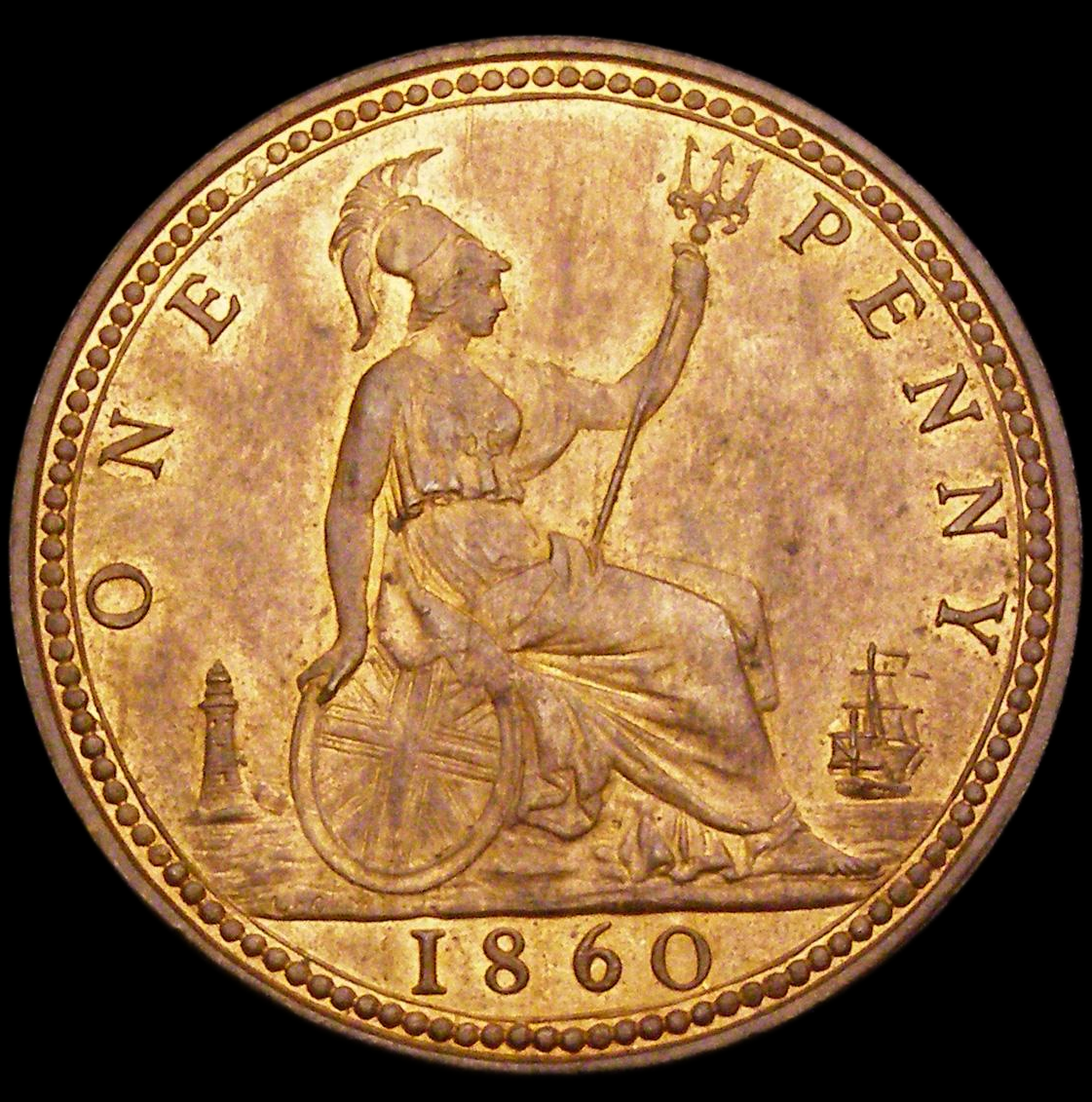
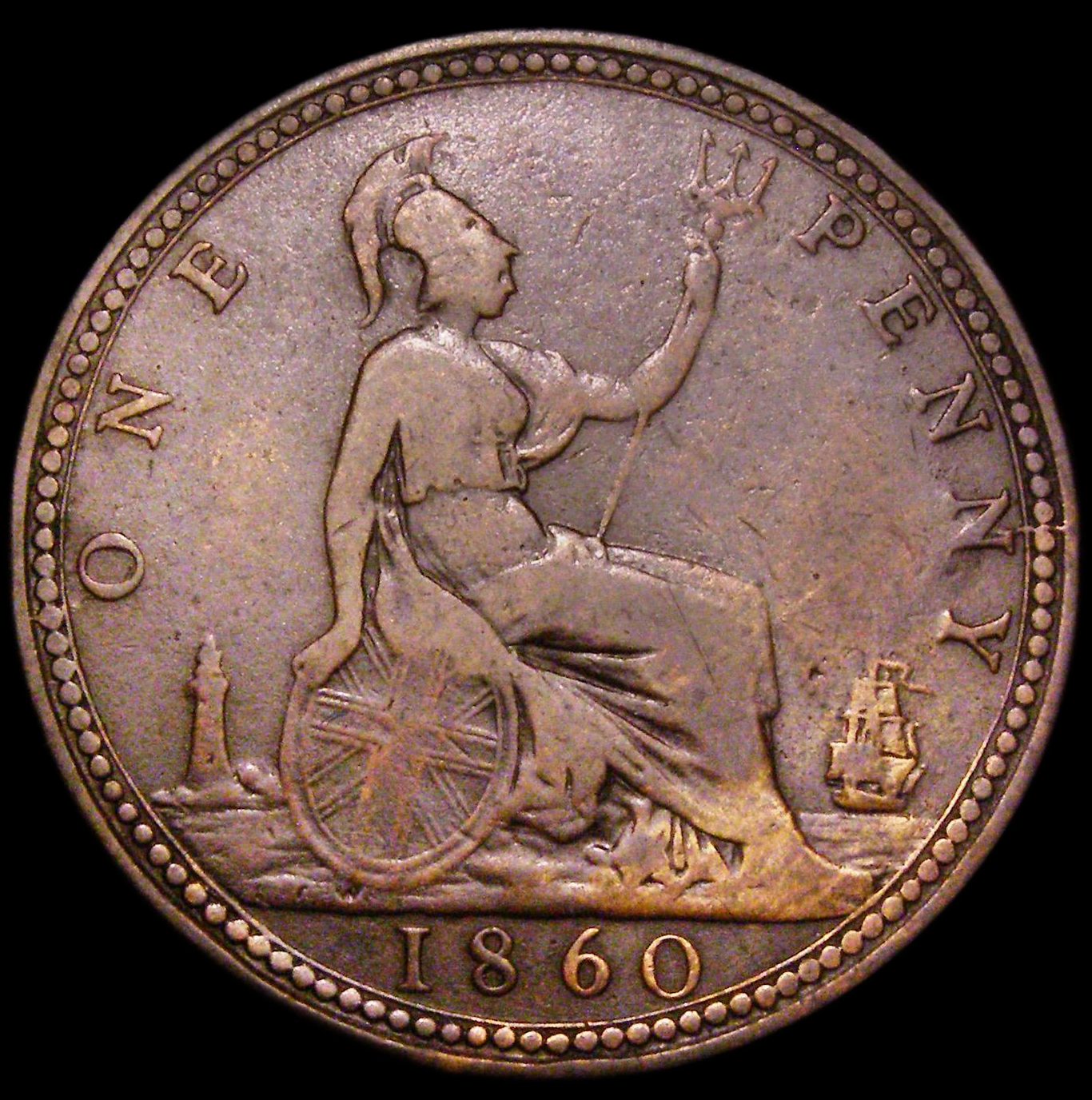
Focus on Britannia’s shield, thumb position, lighthouse, sea, and the location or absence of L.C.W.


Freeman Obverse Types - Identifying Features

Freeman Obverse Date Range Main Diagnostic Features
Obverse 1 1860 Beaded border, normal young head portrait, early mass-produced obverse.
Obverse 1* 1860 Bulging eye, sharper nose and facial profile, early beaded-border trial-style obverse.
Obverse 2 1860–1862 Toothed border, portrait similar to Obverse 1, important transition type.
Obverse 3 1860–1861 Retouched version of Obverse 2, with corrected or heavier detail.
Obverse 4 1860–1861 L.C. WYON visible below bust; finer hair detail.
Obverse 5 1860–1861 Similar to Obverse 4 but without the L.C. WYON signature.
Obverse 6 1860–1874 Later standard Bun Head obverse; higher bust, thinner lettering, no signature.

Freeman Obverse Varieties

Freeman identifies six main Bun Head penny obverse types, with Obverse 1* treated as a retouched variant of Obverse 1.

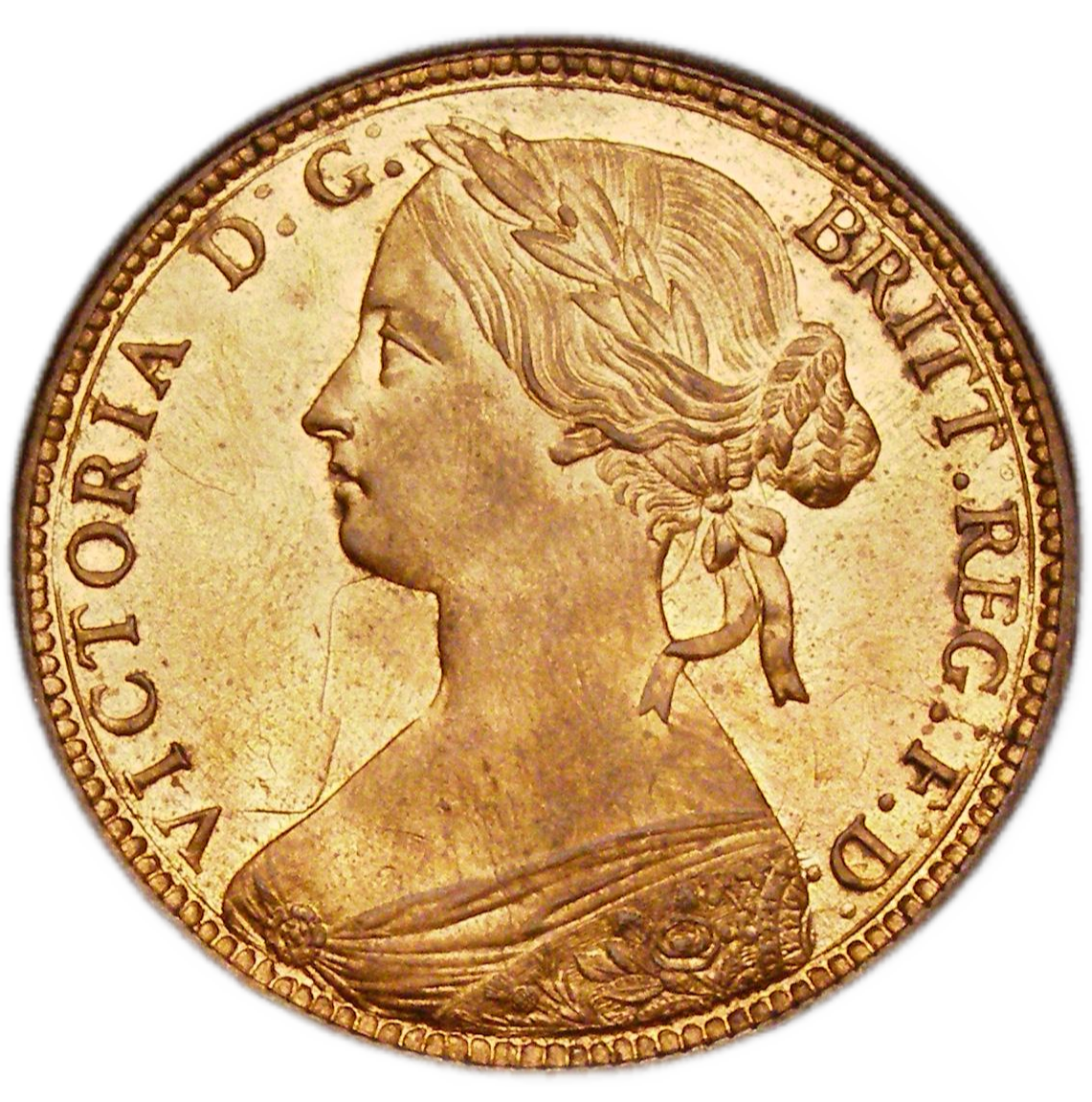
Victoria Bun Head Penny Obverse 1

Image: London Coins

Obv 1 First standard type 1860
  • Bust faces left wearing bodice and mantle embroidered with rose, thistle and shamrock; rose at base of neckline.
  • Small portion of the Star of the Garter visible at the back of the shoulder; inscription HONI SO around it.
  • Hair swept down over the upper half of the ear, backwards in gentle waves to the pleated bun.
  • Wreath of leaves and berries in groups of 3, 3, 3, 4 and 2; leaves show a single raised vein.
  • Ribbon knot below bun; two fish-tailed loose ends hang close together.
  • Separate beaded border, narrow raised rim, and plain linear circle between border and legend.
  • L. C. Wyon signature in very small letters at the lowest extremity of the bust, partly on and partly beneath it.
Victoria Bun Head Penny Obverse 1 star variety
Obv 1* Retouched Variant of Obverse 1 1860
  • Similar to Obverse 1, but the eyeball bulges noticeably at the lid, giving a more pronounced facial appearance.
  • Eye sits lower in relation to the bridge of the nose, while the forehead appears slightly more rounded.
  • Hair detail and wreath leaves may appear weak or softened due to die polishing.
  • Considered a pattern-related obverse, later adapted for currency production after retouching.
  • Usually paired with early 1860 reverses and associated with the earliest Bun Head transition issues.
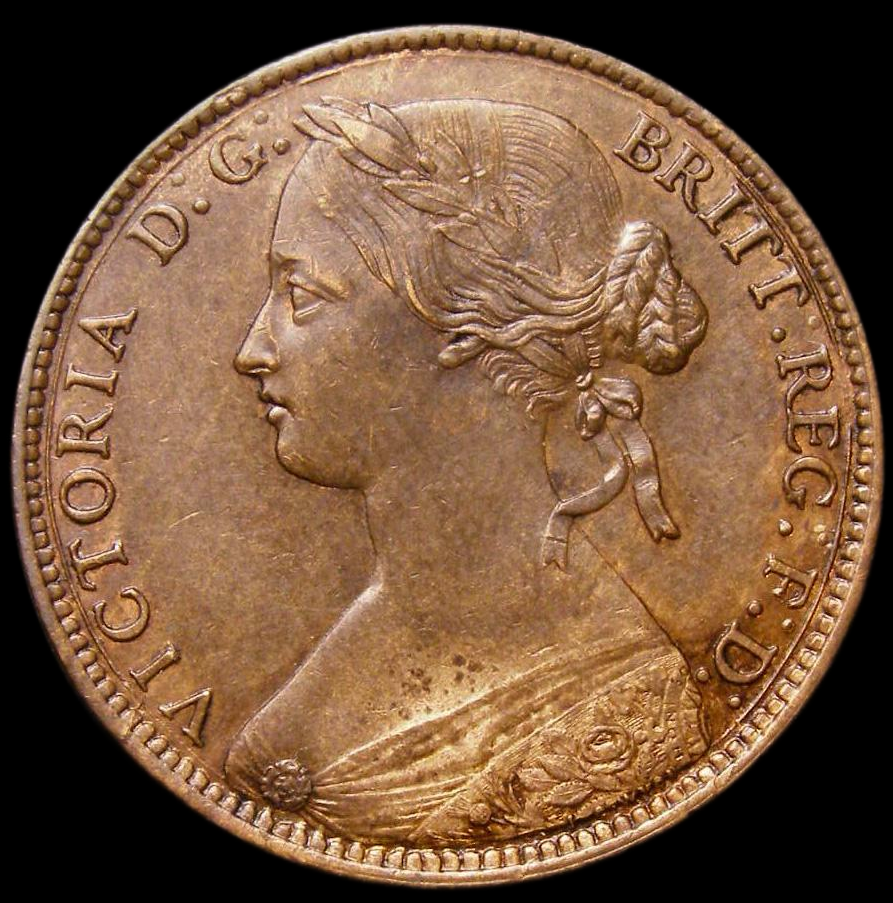
Victoria Bun Head Penny Obverse 2

Image: London Coins

Obv 2 Toothed-Border Type 1860–62
  • Similar to Obverse 1, but the beaded border is replaced by tooth-like denticles adjoining the rim.
  • Hair below the wreath appears slightly more wavy than on Obverse 1.
  • Distinctive curls curve downwards and backwards at the nape of the neck.
  • Usually at least one of the final letters in BRITT is out of alignment, often sloping clockwise.
  • L. C. Wyon signature is clearly separated from the toothed border.
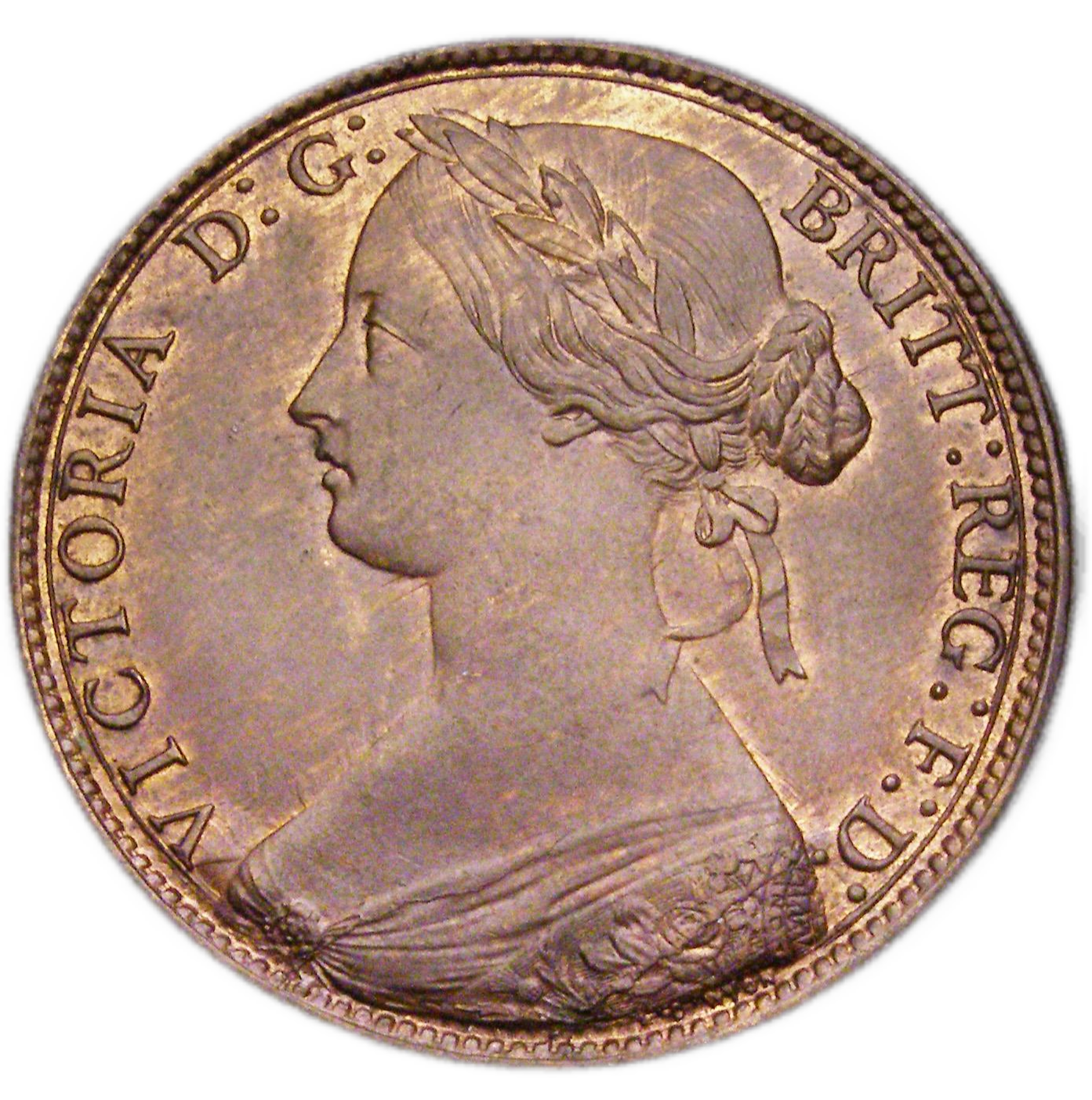
Victoria Bun Head Penny Obverse 3

Image: London Coins

Obv 3 Retouched / Incuse-Outline Wreath 1860–61
  • Retouched version of Obverse 2.
  • Selected leaves in the wreath show incuse outlining, especially the upper leaf of the second cluster and the left leaf of the lower pair.
  • Base of the bust extends further towards the toothed border; neckline rose is complete.
  • L. C. Wyon signature almost touches the border.
  • Legend lettering is slightly larger, with BRITT usually correctly aligned.
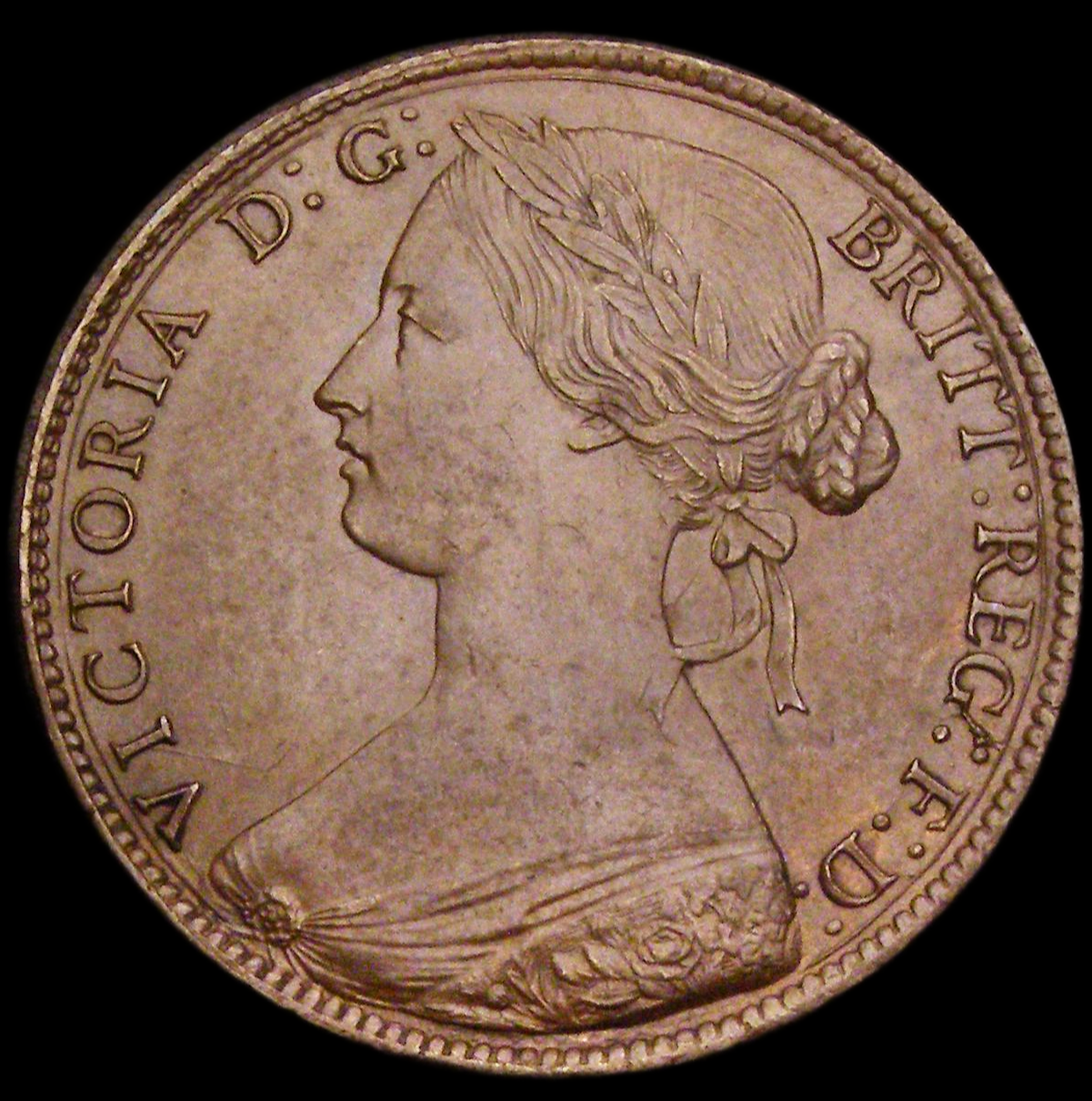
Victoria Bun Head Penny Obverse 4

Image: London Coins

Obv 4 Signature Below Bust 1860–61
  • Similar to Obverse 3, but L. C. WYON appears below the bust rather than partly on it.
  • The initial “L” of L. C. WYON is often flawed and may resemble a truncated letter or a “T”.
  • Hair at the nape is formed of finer strands and sweeps upwards towards the ear.
  • Border teeth are shorter and the rim is narrower than on Obverses 2 and 3.
  • Bust is deeper and more sharply defined; BRITT may occasionally appear misaligned.
Victoria Bun Head Penny Obverse 5

Image: London Coins

Obv 5 No Signature / Double-Incuse Leaf Veins 1860–61
  • Closely related to Obverse 4, but without the L. C. Wyon signature.
  • A small recess remains in the bust outline where the signature previously appeared.
  • Leaf veins within the wreath are now formed by double incuse lines.
  • Several leaves in the second row show incuse outlining.
  • Ribbon ends are thinner and more recessed than on earlier obverses.
Victoria Bun Head Penny Obverse 6

Image: London Coins

Obv 6 Redesigned Standard Working Type 1860–74
  • Rim and border extend further inwards, placing the bust higher on the flan.
  • Wreath now contains sixteen leaves, including an additional leaf behind the uppermost leaf of the fourth cluster.
  • All leaf veins are raised rather than incuse.
  • Hair below the wreath is more wavy, with a distinctive curl extending downwards before curving back upwards.
  • Nose appears slightly sharper and the eye sits closer to the edge of the portrait.
  • Legend lettering is thinner; the “B” of BRITT often nearly touches the portrait.
  • No L. C. Wyon signature and no recess within the bust outline.

Freeman Reverse Types

Freeman Reverse Date Range Main Diagnostic Features
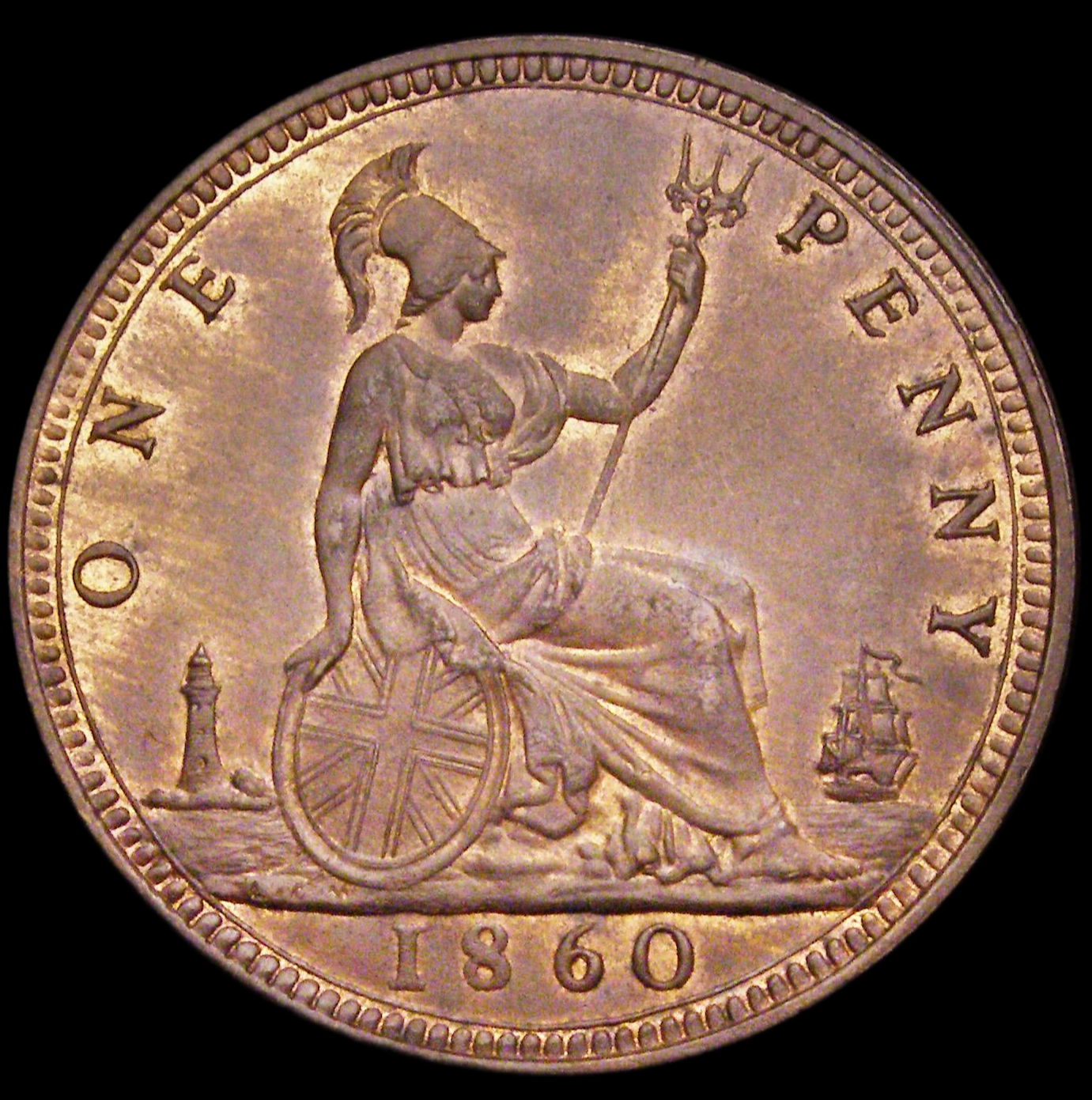
Reverse A 1860 Early beaded-border reverse; Britannia’s thumb does not touch St George’s cross.
Reverse B 1860 Shield cross formed by three incuse lines.
Reverse C 1860 Shield cross formed by two wider raised lines; thumb touches St George’s cross.
Reverse D 1860–1861 Toothed-border version of the early reverse; LCW may be weak or missing.
Reverse E 1860 Incuse L.C.W. below Britannia’s foot; scarce short-lived reverse.
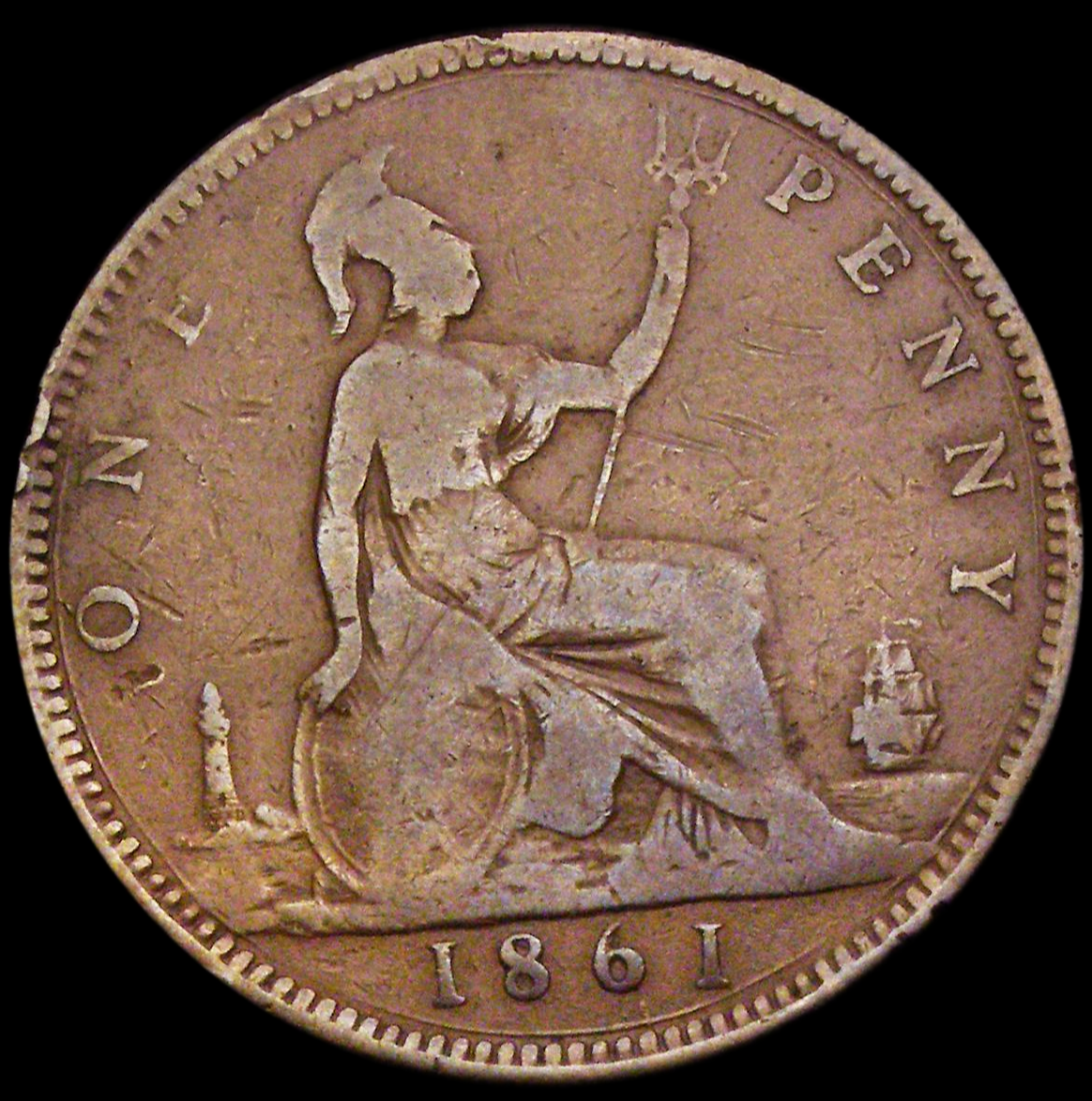
Reverse F 1861 Rounded lighthouse top; LCW removed; transitional reverse.
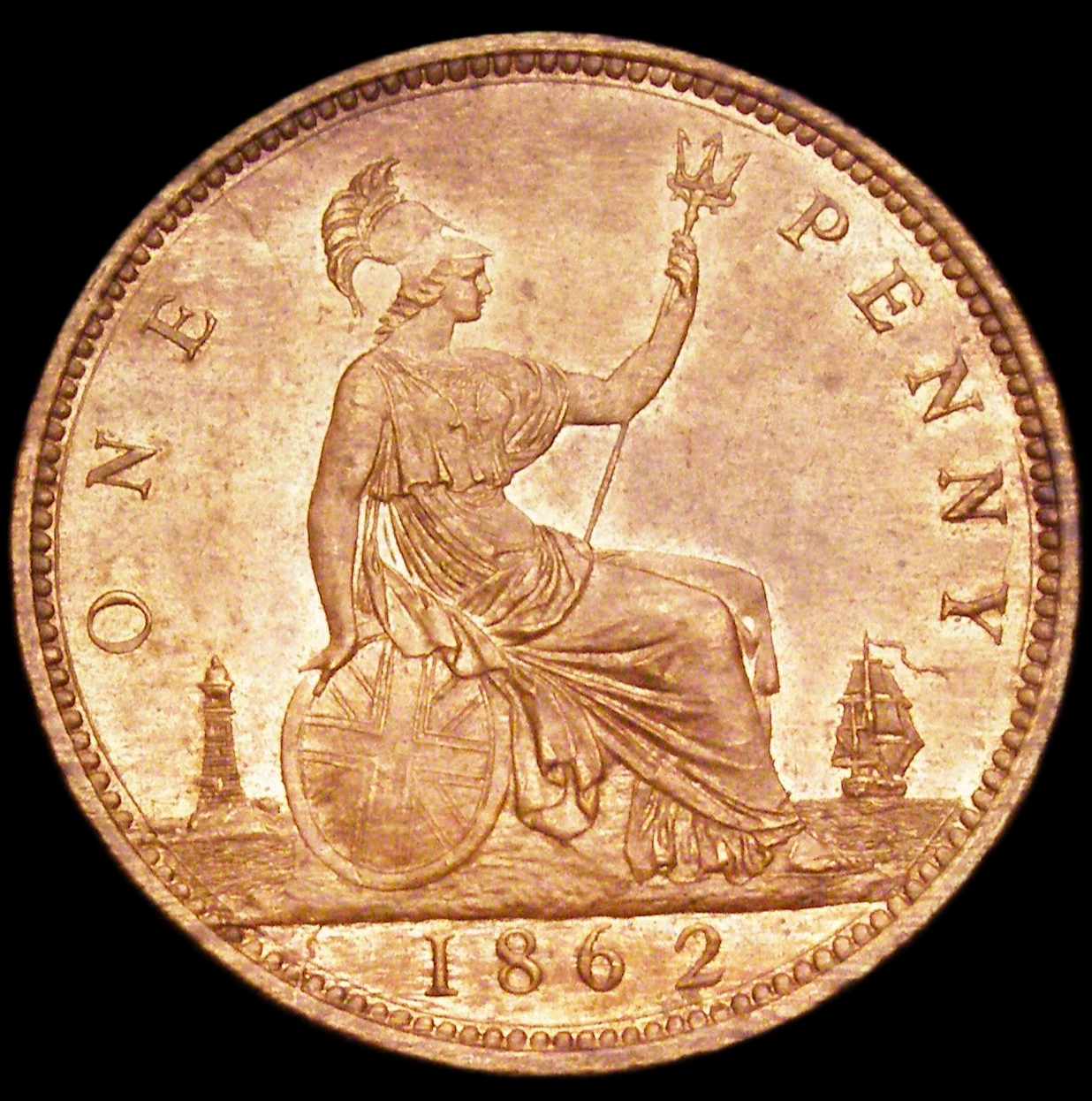
Reverse G 1861–1875 Smaller Britannia, simplified sea, shorter trident prongs, later standard reverse.

Freeman Reverse Varieties - Identifying Features

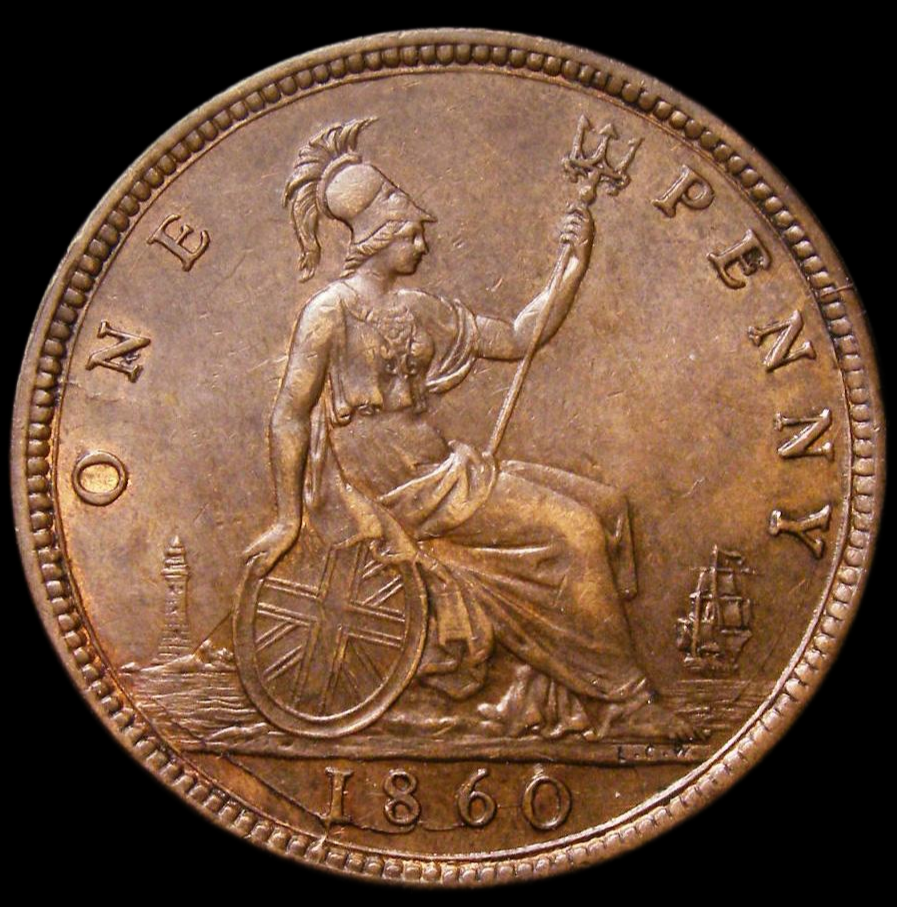
Freeman reverse types are primarily identified through the shield lines, Britannia’s thumb position, lighthouse shape, sea and rock detail, border style, and the presence or absence of L. C. W.

Victoria Bun Head Penny Reverse A

Image: London Coins

Rev A Original Type 1860
  • Shield crosses outlined with close double raised lines.
  • Britannia’s thumb does not fully reach the end of St George’s Cross.
  • Rock mass does not extend leftwards to the linear circle.
  • Lighthouse top is triangular in form.
  • Ship appears to float slightly above the sea line rather than within the waves.
  • No incuse hemline appears on the drapery surrounding the shield.
Victoria Bun Head Penny Reverse B

Image: London Coins

Rev B Treble Incuse Shield Lines 1860
  • Shield crosses formed from treble incuse lines.
  • Britannia’s thumb touches the left end of St George’s Cross.
  • Incuse hemline visible on the drapery fold immediately to the right of the shield.
Victoria Bun Head Penny Reverse C

Image: London Coins

Rev C Raised Shield Lines 1860
  • Shield cross lines are raised, thinner, and spaced farther apart.
  • Britannia’s thumb touches St George’s Cross.
  • Rock extends leftwards to the linear circle.
  • Incuse hemline appears beside the shield and on the upper overlapping fold.
  • Sea extends beyond the linear circle on both sides.
Victoria Bun Head Penny Reverse D

Image: London Coins

Rev D Toothed-Border Reverse 1860–61
  • Similar to Reverse C, but border dots are elongated and tooth-like.
  • Border teeth adjoin the rim directly.
  • Sea and rock detail differ slightly from earlier reverses.
  • Die flaws are common around the lighthouse top, trident prongs, and L. C. W.
  • Exergual line curves upwards slightly where it meets the left linear circle.
  • Some examples show the well-known “ONF PENNY” flaw.
Victoria Bun Head Penny Reverse E

Image: London Coins

Rev E L. C. W. Below Britannia’s Foot 1860
  • Based on Reverse D but distinguished by incuse L. C. W. beneath Britannia’s foot.
  • Shield rim appears thicker than on earlier reverses.
  • Helmet plume resembles Reverses A and B, including the small additional feather.
  • Lighthouse masonry and sea waves are sharply defined.
  • No upward curve appears in the exergual line.
Victoria Bun Head Penny Reverse F

Image: London Coins

Rev F No L. C. W. / Transitional Reverse 1861
  • L. C. W. removed; rocks replace the sea near the former initials.
  • Rock line touches the shield rim below the lower left limb of St Andrew’s Cross.
  • Lighthouse top is rounded with a small knop-like tip.
  • Several close horizontal lines appear around the lowest lighthouse platform.
  • Helmet plume is thicker and hangs closer to Britannia’s shoulder.
  • Fine line appears beneath the left underside of the ship.
Victoria Bun Head Penny Reverse G

Image: London Coins

Rev G Standardised Later Reverse 1861–75
  • Design and lettering are smaller and positioned lower on the flan.
  • No L. C. W. initials present.
  • Shield becomes noticeably convex compared with earlier flatter reverses.
  • Sea crosses the linear circle continuously and extends fully to the border.
  • Lighthouse top is bell-shaped with a small rounded tip.
  • Border teeth are shorter; the letter “O” is rotated anti-clockwise.
  • Trident prongs are shorter and closer together.
  • Ship sits naturally within the sea rather than above it.

Freeman Pairing Table: Early Bun Head Pennies

Freeman No. Year Obverse Reverse Notes
F118601AStandard early currency type.
F2–F518601AProof and flan variations.
F618601BBeaded-border pairing.
F718601CBeaded-border pairing.
F818601DMule-style beaded/toothed transition pairing.
F8A–F8D18601*A–DEarly modified obverse pairings.
F9–F1718602–6B–DMain 1860 transition group.
F18–F3718612–6D, F, G1861 transition and standardisation group.
F38–F4118622 or 6GMostly standard Reverse G group.
F42–F4718636GStandard Obverse 6 and Reverse G group.

Practical Attribution Workflow

  1. Start with the border: beaded or toothed.
  2. Identify the obverse using the eye, bust, lettering and signature.
  3. Identify the reverse using the shield, thumb, lighthouse and sea.
  4. Match the obverse and reverse combination to the Freeman number.
  5. Only then check for smaller die varieties, overdates, repairs or date numeral differences.


EKX