
Articles: 1893 Victoria Crown Proof and Circulation Strike Comparison
1893 Crown Proof vs Circulation Strike
Old Head / Veiled Head Crown Comparison • Surface finish • Strike sharpness • Edge detail • Visual diagnostics
Introduction
The 1893 Crown was issued in both normal circulation-strike form and special proof form. At first glance both types share the same basic design: Queen Victoria’s Old Head, or Veiled Head, portrait on the obverse and Benedetto Pistrucci’s St George and the Dragon reverse.
The difference lies in the method of striking, surface finish, sharpness of detail and overall presentation. Proof coins were specially prepared collector pieces, while circulation strikes were made for ordinary use.
For collectors, correctly identifying the difference matters because proof crowns are scarcer, usually more valuable, and often show very different surface characteristics from ordinary currency examples.
Quick Navigation
Proof Strike and Circulation Strike: Key Differences
| Feature | Circulation Strike | Proof Strike |
|---|---|---|
| Purpose | Produced for normal use | Produced as a special collector or presentation issue |
| Fields | Satin, lustrous or lightly reflective | Highly reflective, mirror-like fields |
| Design Detail | Can show weakness on high points | Usually sharper and more fully struck |
| Obverse Beads | Normal rounded bead appearance | May appear longer and more denticle-like on proof-die examples |
| Surface Marks | Contact marks and circulation friction are common | Usually better preserved, but hairlines can be very visible |
| Collector Appeal | Popular as a first-year Old Head crown | Scarcer and usually more desirable in high grade |
Visual Comparison
A side-by-side comparison is often the clearest way to understand the difference between a normal circulation strike and a proof strike.
Obverse Comparison
Circulation Strike Obverse
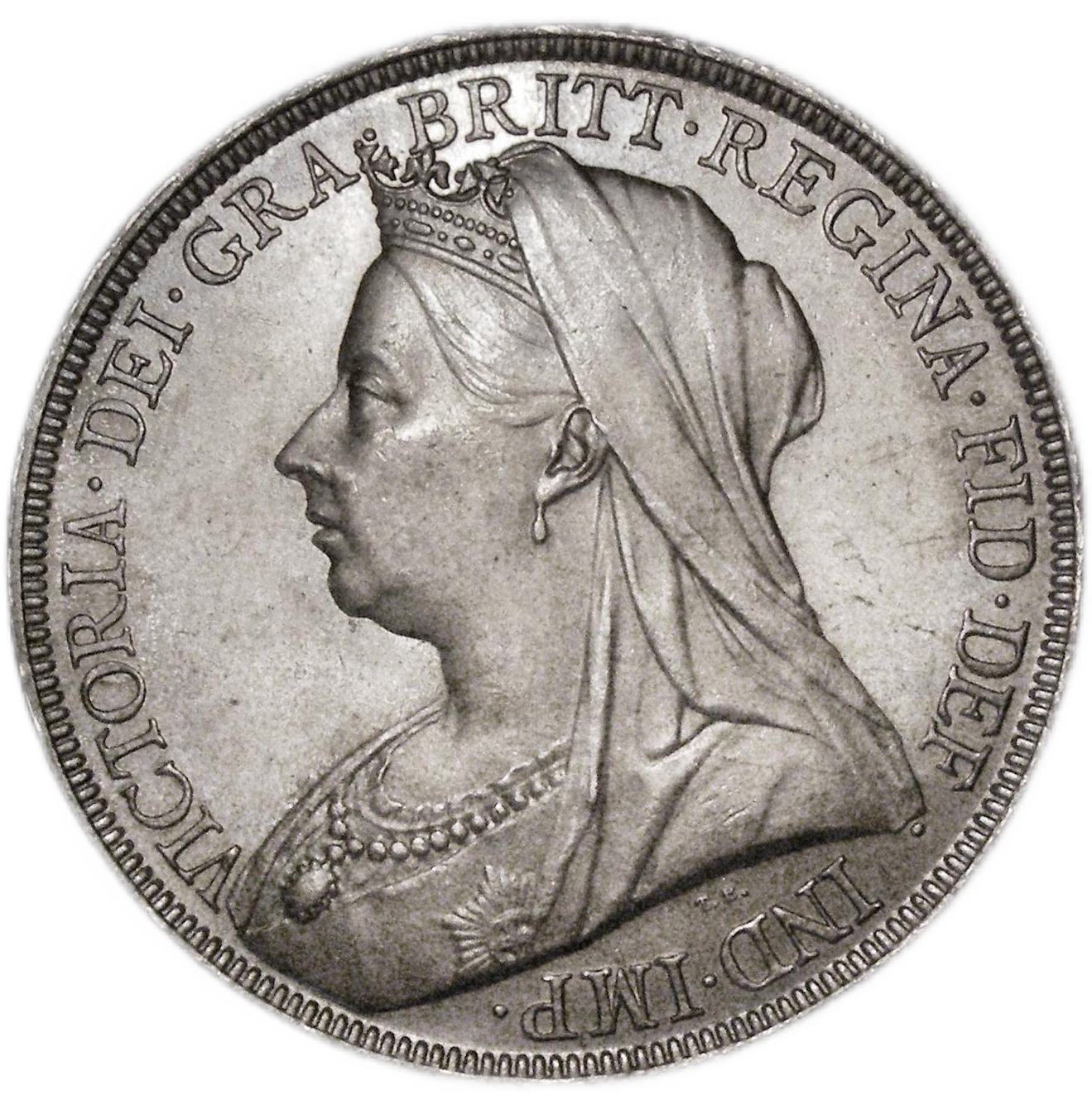
Image: London Coins Auction
- Usually shows satin lustre rather than deep mirror fields.
- High points may show minor softness or cabinet friction.
- Contact marks are more commonly seen on exposed areas.
- Attractive examples can still show strong eye appeal.
Proof Strike Obverse
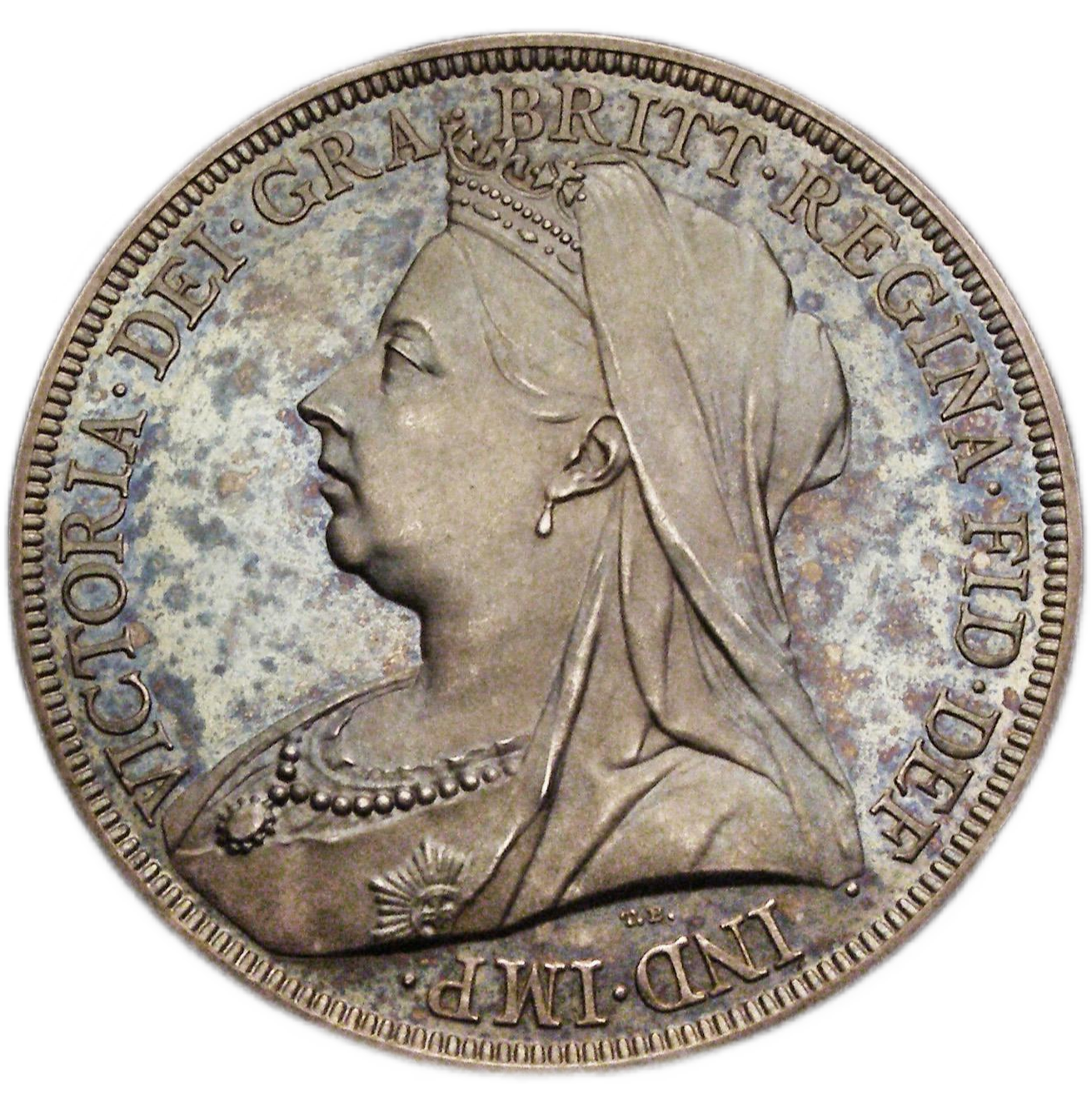
Image: London Coins Auction
- Fields should appear more reflective and mirror-like.
- Portrait, border and lettering detail usually appear crisper.
- Veil folds and hair detail should show stronger definition.
- Hairlines may be very visible if the proof has been wiped.
Reverse Comparison
Circulation Strike Reverse
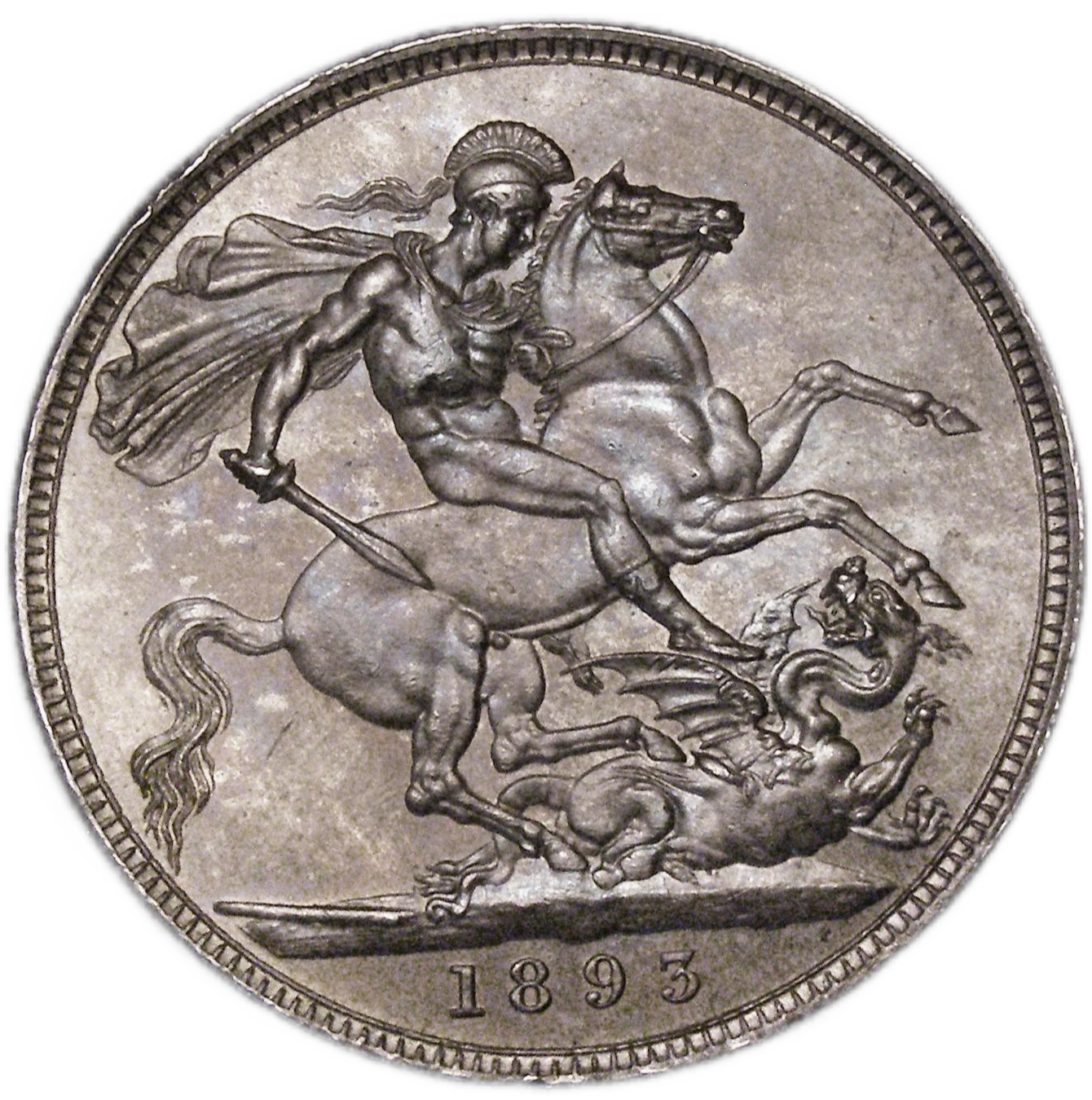
Image: London Coins Auction
- Fields normally appear less reflective than a proof strike.
- Minor softness may appear on the horse, dragon and exergue.
- Contact marks and cabinet friction may be present.
- Strong examples can still show attractive original lustre.
Proof Strike Reverse
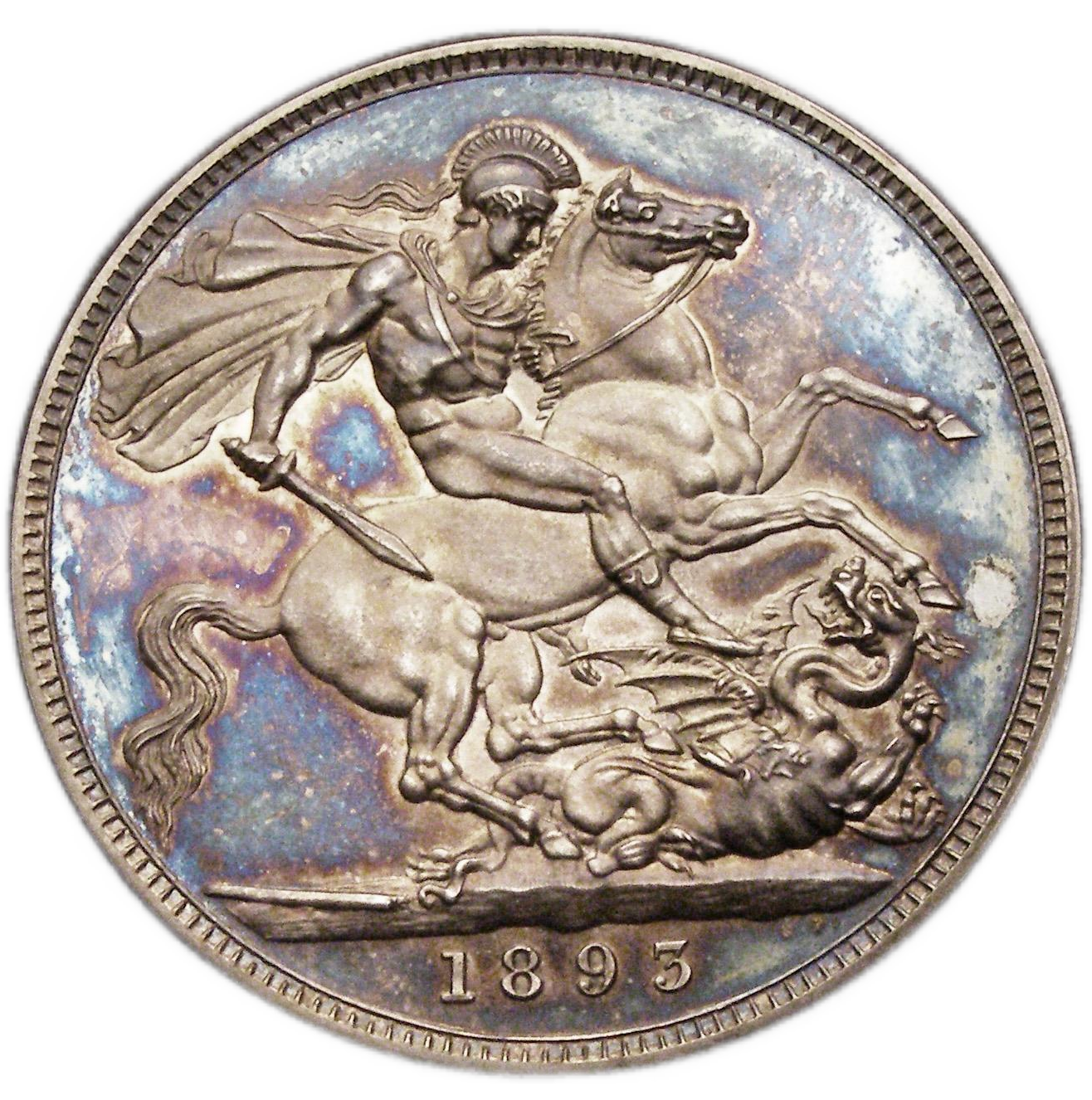
Image: London Coins Auction
- Mirror-like fields should be visible around St George.
- Horse musculature and dragon detail usually appear sharper.
- The exergue, date and B.P. initials should appear crisper.
- Surface hairlines may show strongly under direct light.
When comparing images, lighting and photography can make a major difference. A bright circulation strike may look prooflike in a photograph, while a genuine proof can appear dull if poorly lit or heavily toned. The safest approach is to compare several features together: fields, strike sharpness, edge inscription, bead form and overall surface character.
Surface Finish
Surface finish is often the first thing collectors examine when comparing a proof 1893 Crown with a circulation strike.
A circulation strike normally shows mint lustre, satin texture or light reflectivity depending on preservation, cleaning history and die state. Even high-grade circulation examples usually do not show the deep mirrored fields expected on a true proof.
A proof strike should show much stronger reflectivity in the fields. The flat areas around Victoria’s portrait and around St George should appear mirror-like when viewed under light.
However, surface finish alone should not be used as the only test. Some circulation strikes can appear prooflike, while cleaned or polished coins can imitate brightness without having genuine proof characteristics.
Strike Sharpness
Proof coins were struck with greater care than normal currency pieces. As a result, the design details are usually sharper and more complete.
On the obverse, collectors should examine:
- Victoria’s veil folds
- Hair detail above the forehead
- The small crown and jewellery detail
- The sharpness of the lettering and border
On the reverse, useful comparison points include:
- St George’s body and armour
- The horse’s shoulder and chest
- The dragon’s body, wing and scales
- The exergue and date area
- Pistrucci’s B.P. initials
Circulation strikes can still be very attractive, especially when well-preserved, but they often show minor softness in these high-relief areas.
Edge and Regnal Year
The edge inscription should be checked when comparing a circulation strike with a proof or proof-die 1893 Crown.
DECUS ET TUTAMEN ANNO REGNI LVI
DECUS ET TUTAMEN ANNO REGNI LVII
The Latin translates as: “An ornament and a safeguard, in the year of the reign 56 / 57.”
The key diagnostic point is the final Roman numeral:
- LVI — Regnal Year 56
- LVII — Regnal Year 57
The standard 1893 proof Crown is normally found with the LVI edge inscription.
A separate and scarcer LVII edge variety also exists and is associated with certain proof-die characteristics, but it should not be confused with the standard proof issue itself.
The LVII edge is especially significant because it is associated with scarcer proof-die pieces. For this reason, the edge should be considered alongside mirror fields, strike sharpness, bead form and overall surface character.
A bright or reflective coin should not be judged as a proof from surfaces alone. Edge inscription and die evidence provide important supporting confirmation.
Common Areas of Confusion
The biggest mistake is assuming that a bright or reflective coin must automatically be a proof. This is not always correct.
A circulation strike may look reflective because of:
- Die polishing
- Prooflike fields
- Later cleaning or polishing
- Photography and lighting effects
Equally, a proof coin may not look perfect if it has been mishandled, wiped, cleaned or stored poorly. Hairlines can be especially visible in proof fields.
The safest approach is to assess several features together: surface reflectivity, sharpness of strike, edge type, bead form, preservation and any specialist reference attribution.
Collector Notes
For most collectors, a high-grade circulation strike of the 1893 Crown is already a desirable coin because it represents the first year of the Old Head crown series.
Proof examples occupy a more specialist position. They are scarcer, often sharper, and usually command stronger premiums when the surfaces are original and attractive.
When comparing examples, originality is critical. A naturally toned circulation strike with strong eye appeal may be more desirable than a bright, cleaned coin. Similarly, a proof with heavy hairlines may be less appealing than a cleaner example with balanced toning.
The best examples combine sharp strike, attractive surfaces, clean rims, strong eye appeal and clear attribution.