
Articles: Victoria Old Head Crown Guide
1893 Old Head Crown
Queen Victoria’s First Veiled Head Crown • Strike quality • Proof issues • Grading hotspots • Toning and key diagnostics
Introduction
The 1893 Crown introduced the famous Old Head, or Veiled Head, portrait of Queen Victoria — a design created by sculptor and engraver Thomas Brock.
Replacing the earlier Jubilee portrait, the new effigy presented Victoria as an elderly empress and widow, wearing a small crown beneath a flowing veil. The portrait quickly became one of the most respected and recognisable designs of late Victorian coinage.
Combined with Benedetto Pistrucci’s classic St George and the Dragon reverse, the 1893 Crown remains one of the most popular large silver British coins amongst collectors today.
As the first year of the Old Head crown series, the 1893 issue also holds important type significance within Victorian silver coinage.
Quick Navigation
Specifications
| Monarch | Queen Victoria |
|---|---|
| Denomination | Crown |
| Year | 1893 |
| Metal | Sterling Silver (.925) |
| Weight | 28.276 grams |
| Diameter | 38.6 mm |
| Edge | Milled |
| Obverse Designer | Thomas Brock |
| Reverse Designer | Benedetto Pistrucci |
| Spink Reference | S-3937 |
Obverse - The Old Head Portrait
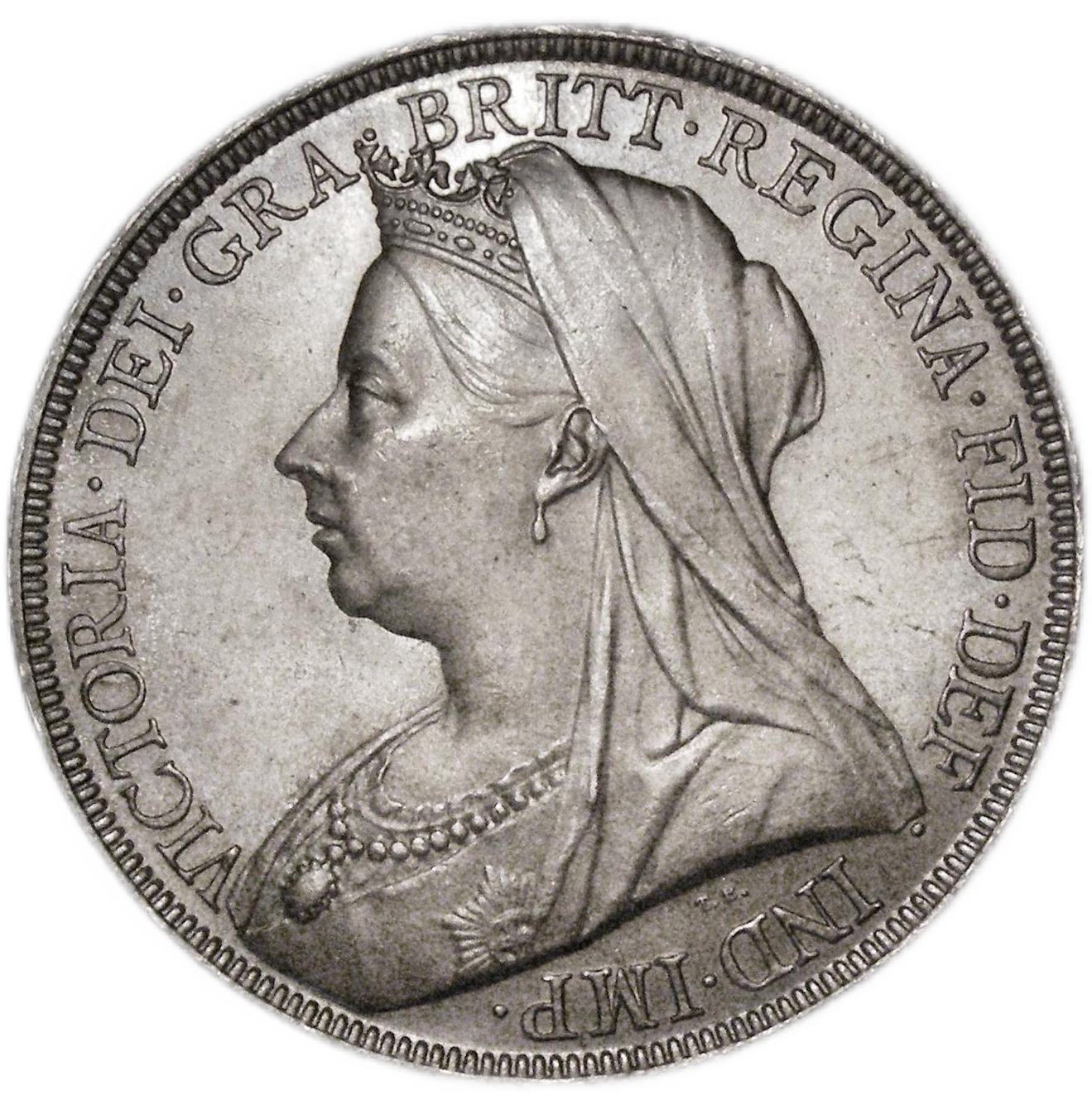
Image: London Coins
The obverse features the celebrated Old Head, or Veiled Head, portrait of Queen Victoria facing left.
Designed by Thomas Brock, the portrait presents Victoria as an ageing monarch and Empress of India, wearing a small diamond crown beneath a widow’s veil.
The portrait replaced the earlier Jubilee Head design and was generally received far more positively by both collectors and the public.
VICTORIA DEI GRA BRITT REGINA FID DEF IND IMP
The legend translates to:
Victoria, by the Grace of God, Queen of Britain, Defender of the Faith, Empress of India.
Reverse - St George and the Dragon Reverse
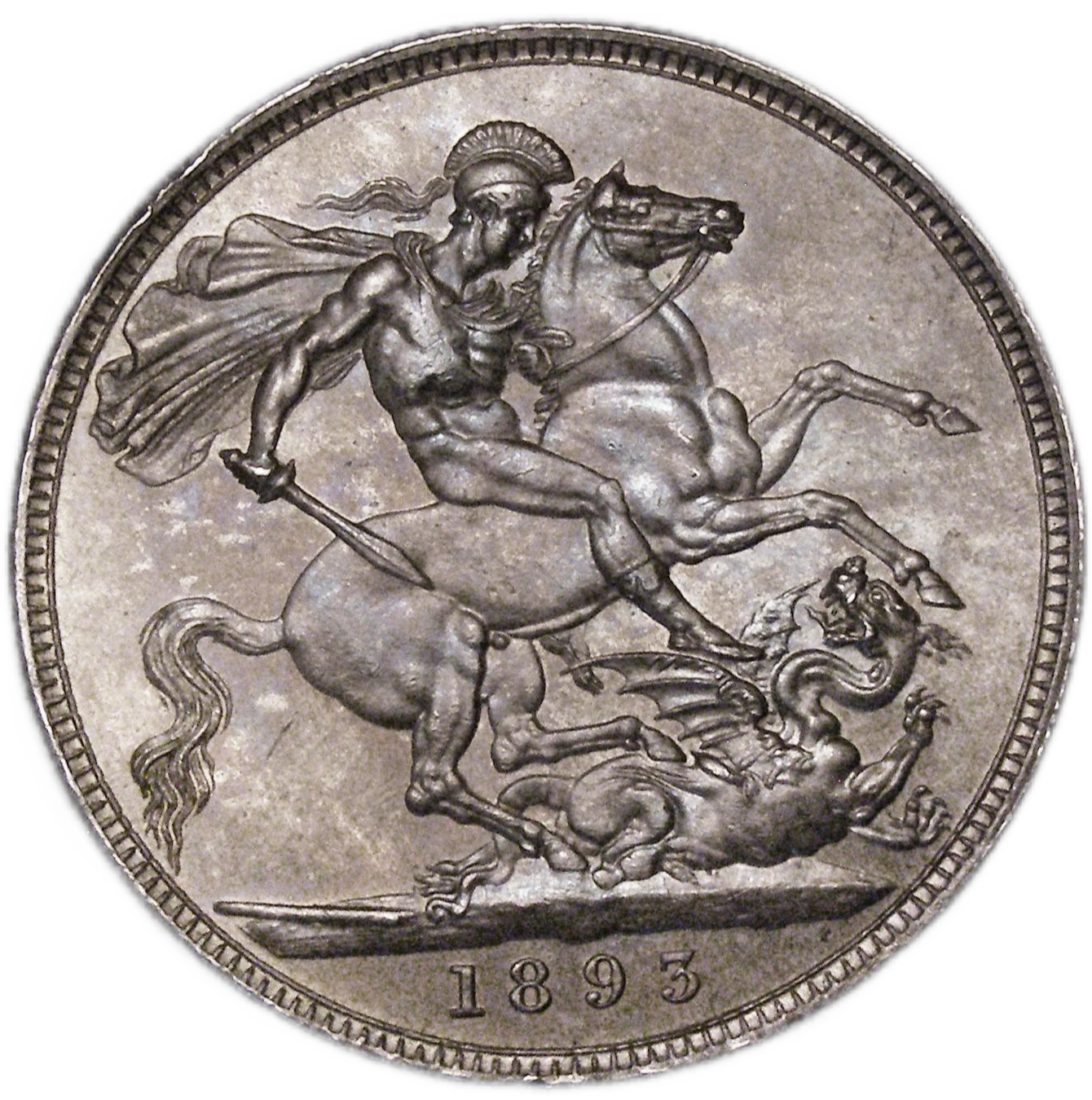
Image: London Coins
The reverse uses Benedetto Pistrucci’s famous St George and the Dragon composition — one of the most iconic designs in British numismatics.
Originally created for the sovereign in 1817, the design depicts St George on horseback defeating the dragon beneath him.
On well-struck examples, collectors often examine:
- Horse musculature and chest detail
- Dragon scales and wings
- Ground-line sharpness
- Date positioning in the exergue
- Pistrucci’s tiny “B.P.” initials
The combination of Brock’s mature portrait and Pistrucci’s reverse is one of the defining visual pairings of late Victorian silver.
Edge and Edge Inscription
Like many nineteenth-century British crowns, the 1893 Crown features a lettered edge rather than a plain milled finish.
The standard edge inscription reads:
DECUS ET TUTAMEN ANNO REGNI LVI
Some 1893 Crown examples are recorded with the alternative regnal-year inscription:
DECUS ET TUTAMEN ANNO REGNI LVII
The Latin may be understood as: “An ornament and a safeguard, in the year of the reign 56 / 57.”
- DECUS ET TUTAMEN — an ornament and a safeguard
- ANNO REGNI — in the year of the reign
- LVI — Regnal Year 56
- LVII — Regnal Year 57
The phrase DECUS ET TUTAMEN refers to the decorated edge itself. It was both ornamental and practical, helping protect the coin against clipping or edge tampering.
Both circulation strikes and the standard proof issue are normally found with the LVI edge inscription, while the scarcer LVII edge occurs on recognised specialist varieties.
For the 1893 Crown, the difference between LVI and LVII is also important for specialist attribution, as certain edge types are linked with particular die pairings and varieties.
A more detailed breakdown of recognised edge varieties and die pairings can be found in the dedicated 1893 Crown Varieties Guide .
Strike Quality and Eye Appeal
Strike quality varies noticeably across surviving 1893 Crowns.
Many examples show softness in the highest areas of the design, particularly around:
- The veil folds
- Hair above the forehead
- Horse shoulder and chest
- Dragon detail
Strongly struck examples with sharp detail throughout are considerably more desirable and often command substantial premiums.
Collectors also place significant emphasis on:
- Original mint lustre
- Undisturbed surfaces
- Natural toning
- Clean rims and edge quality
Proof and Currency Strikes
The 1893 Crown exists in both standard currency strike and proof form.
| Currency Strike | Proof Strike |
|---|---|
| Produced for circulation | Special collector issue |
| Softer satin surfaces | Mirror-like reflective fields |
| Often weaker strike | Sharper detail throughout |
| More common | Scarcer and more expensive |
| Contact marks common | Usually better preserved |
Grading Considerations
Victorian crowns are heavily collected in higher grades, making originality and surface quality extremely important.
On the 1893 Crown, wear typically first appears on:
- Victoria’s cheek
- Veil folds
- Hair detail
- Horse shoulder
- Dragon scales
Cleaning is particularly common on Victorian crowns, and collectors generally prefer coins with original surfaces and natural toning.
Harshly cleaned examples often display:
- Fine hairlines
- Bright unnatural silver colour
- Dull grey overdipped surfaces
- Reduced eye appeal
Toning and Surface Preservation
Original toning plays a major role in the desirability of Victorian silver crowns.
Collectors particularly value:
- Peripheral rainbow toning
- Blue and gold cabinet toning
- Deep old collection patina
- Evenly balanced natural colour
Coins with strong eye appeal, attractive toning and full lustre often realise significant premiums at auction.
Collector Notes
As the first year of the Old Head crown series, the 1893 issue remains one of the most popular Victorian crowns amongst both type collectors and silver crown specialists.
While not rare in lower grades, original examples with strong strike, attractive toning and minimal surface disturbance become far more difficult to locate.
Proof examples are substantially scarcer and remain highly sought after, particularly in higher certified grades.
More than a century after issue, the 1893 Crown continues to represent one of the defining large silver coins of late Victorian numismatics.